


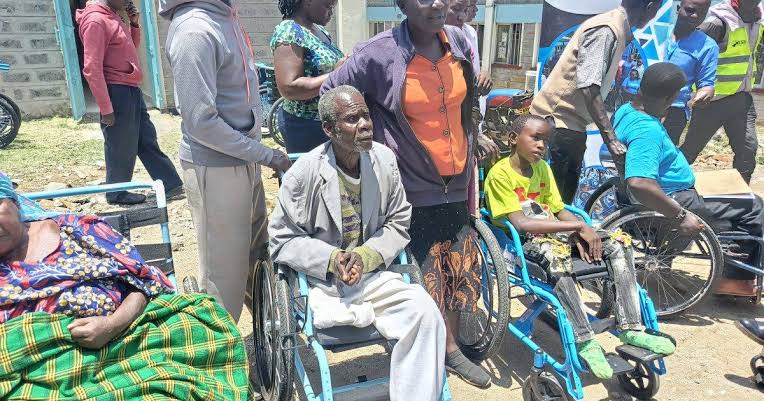
Despite existing disability laws aimed at guaranteeing equal access, persons with disabilities in Lagos State continue to face significant barriers in accessing public buildings, transportation and essential services, disability rights organisations have said.
The organisations, under the auspices of the Down Syndrome Foundation Nigeria and the Festus Fajemilo Foundation, made the assertion during a press conference held on Monday to mark the successful completion of a statewide accessibility advocacy project implemented across the nine disability clusters of the Joint Association of Persons with Disabilities (JONAPWD) in Lagos State.
The groups expressed concern over what they described as widespread disregard for accessibility standards in the design and management of public infrastructure, noting that thousands of persons with disabilities remain excluded from opportunities and services that should ordinarily be available to all citizens.
They also declared that accessibility and disability inclusion would remain key issues in their advocacy and engagement with policymakers and political office seekers as the country gradually prepares for the 2027 general elections.
Speaking at the event, the National President of the Down Syndrome Foundation Nigeria, Mrs. Rose Mordi, said the advocacy campaign was designed to ensure that persons with disabilities enjoy the rights already guaranteed under national and international legal frameworks.
“Our advocacy is about ensuring that persons with disabilities enjoy the rights already guaranteed under the law. Accessibility goes far beyond the construction of ramps. Every category of disability has unique accessibility requirements that must be considered if we are to build a truly inclusive society,” she said.
Mordi observed that many Nigerians, including operators of public facilities, remain unaware of the provisions of Article 9 of the United Nations Convention on the Rights of Persons with Disabilities, the Discrimination Against Persons with Disabilities (Prohibition) Act and the Lagos State Special People’s Law, all of which require public spaces and services to be accessible and inclusive.
Also speaking, the Executive Director of the Festus Fajemilo Foundation, Mr. Afolabi Fajemilo, urged governments, developers and service providers to integrate accessibility into the planning and design of every public project from the outset.
“Accessibility should be integrated from the planning and design stage of every public facility. When accessibility is ignored at the beginning, it creates barriers that exclude millions of Nigerians from education, healthcare, transportation, employment and other essential services,” he stated.
The project’s Technical Consultant, Mrs. Modinat Tijani, explained that accessibility is much broader than the provision of wheelchair ramps, noting that inclusive facilities should include tactile paving for persons with visual impairments, accessible toilets, audio announcement systems, lowered service counters, clear directional signage and other features that enable persons with disabilities to move and access services independently.
She further emphasised that organisations of persons with disabilities should be actively involved from the earliest stages of project planning to ensure that infrastructure and public services reflect the diverse needs of all disability groups.
Representatives of the Spina Bifida and Hydrocephalus Association of Nigeria, the National Association of the Blind, the Spinal Cord Injuries Association and the Albinism Association of Nigeria also shared firsthand accounts of the daily challenges their members encounter while trying to access public buildings, transportation systems and other essential services across Lagos State.
The organisations called on the Lagos State Government, public institutions and private sector operators to strengthen compliance with disability laws, increase public awareness on accessibility standards and ensure that organisations of persons with disabilities are fully involved in the planning, implementation and monitoring of public infrastructure projects.
They added that the findings and recommendations from the statewide accessibility advocacy project would be formally presented to the Lagos State Ministry of Youth and Social Development and other relevant stakeholders to support improved implementation of accessibility laws and accelerate the creation of a more inclusive Lagos where every resident, regardless of disability, can participate fully in society.
Join Inclusive News Network WhatsApp Community For Quick Access To News and Happenings Around You.