


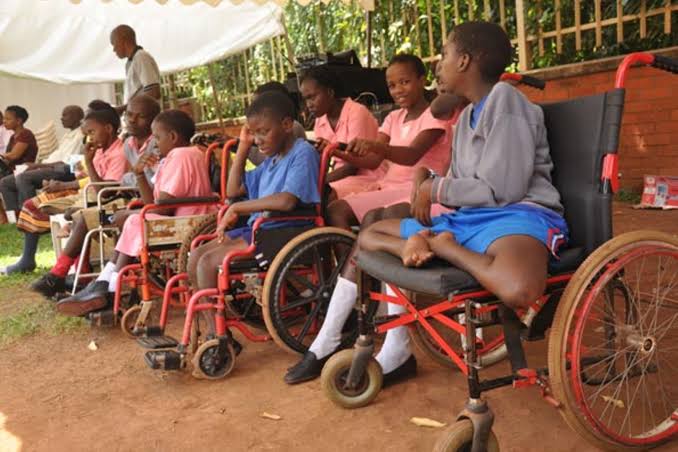
The National Commission for Persons with Disabilities (NCPWD) has commenced a three-day assessment, prescription, fitting and distribution of assistive devices targeting 562 children with disabilities across selected institutions and organisations in the Federal Capital Territory (FCT).
The exercise, which commenced at the University of Abuja Teaching Hospital (UATH), Gwagwalada, and Kuje General Hospital, is introducing a structured and sustainable approach to assistive technology service delivery in Nigeria.
The devices being provided include paediatric wheelchairs, standing frames, axillary crutches, elbow crutches and bath chairs, with the intervention particularly targeting indigent persons with disabilities, especially children with mobility challenges who cannot afford such devices.
Representing the Executive Secretary of the NCPWD, Hon. Ayuba Burki Gufwan, at UATH, the Head of General Services, Mr. Carl Gurumyen, said the Commission was not merely distributing assistive devices but establishing a coordinated, appropriate, safe and sustainable assistive technology system.
Gufwan explained that the Commission had institutionalised a new service pathway comprising Assessment, Prescription, Fitting, Training, Follow-up and Maintenance, guided by the principle: “Appropriate device first; distribution second.”
“An assistive device is only truly useful when it is appropriate for the individual, properly assessed, correctly fitted, adequately explained and supported through appropriate follow-up,” he said.
“Our objective is not merely to place devices in the hands of persons with disabilities. Our objective is to ensure that the right device reaches the right person, is appropriately fitted and used safely, and contributes meaningfully to mobility, independence, learning, participation and quality of life.”
The Executive Secretary said the success of the intervention would not be measured solely by the number of devices distributed, but by their impact on the children’s independent mobility, school participation, access to learning, safety and comfort.
He described the participating hospitals as strategic partners rather than mere recipients of the devices, urging them to ensure proper documentation, safe storage, appropriate allocation, user education and maintenance.
He also called on the hospitals to designate focal persons to liaise with the Commission on utilisation, repairs and emerging needs, while appreciating the ECOWAS Commission for its support under its regional intervention programme.
The Head of the Assistive Devices and Technology Unit of the Commission, Dr. Ismail Idris, said the initiative marked a shift from ad-hoc direct distribution to a structured, hospital-based model.
According to him, under the new approach, assistive devices are donated to hospitals and managed under the professional care of their Physiotherapy Departments to ensure proper assessment, prescription, fitting, training and follow-up.
Also speaking, the Chief Medical Director of UATH, Prof. Thairu Yunusa, represented by the Chairman, Medical Advisory Committee, Prof. Joseph O. Obande, commended the Commission for implementing what he described as a practical expression of Priority Six of the Federal Government’s Eight-Point Renewed Hope Agenda, which focuses on human capital development through education, healthcare and social investment.
Prof. Obande noted that the assistive devices would help persons with disabilities access healthcare and education and pursue their aspirations, while appreciating the NCPWD and the ECOWAS Commission for the intervention.
At Kuje General Hospital, the Chief Medical Director, Dr. Demola Onakomaiya, also commended the Commission for selecting the hospital and assured that the devices would be appropriately allocated to persons who genuinely require them.
The Head of the hospital’s Welfare Department, Mrs. Esther Akwu, who is a person with disability, expressed appreciation for the intervention and commended Dr. Onakomaiya for what she described as his empathy and commitment to persons with disabilities.
She noted that under his leadership, Kuje General Hospital had become the only hospital in the FCT with a dedicated sign language interpreter to support deaf patients.
Akwu, however, appealed to the Commission to extend similar interventions to schools for children with special needs and disabilities in Kuje Area Council, particularly those facing poor infrastructure and other challenges.
The three-day exercise will continue across other selected hospitals and institutions in the FCT.
Join Inclusive News Network WhatsApp Community For Quick Access To News and Happenings Around You.