


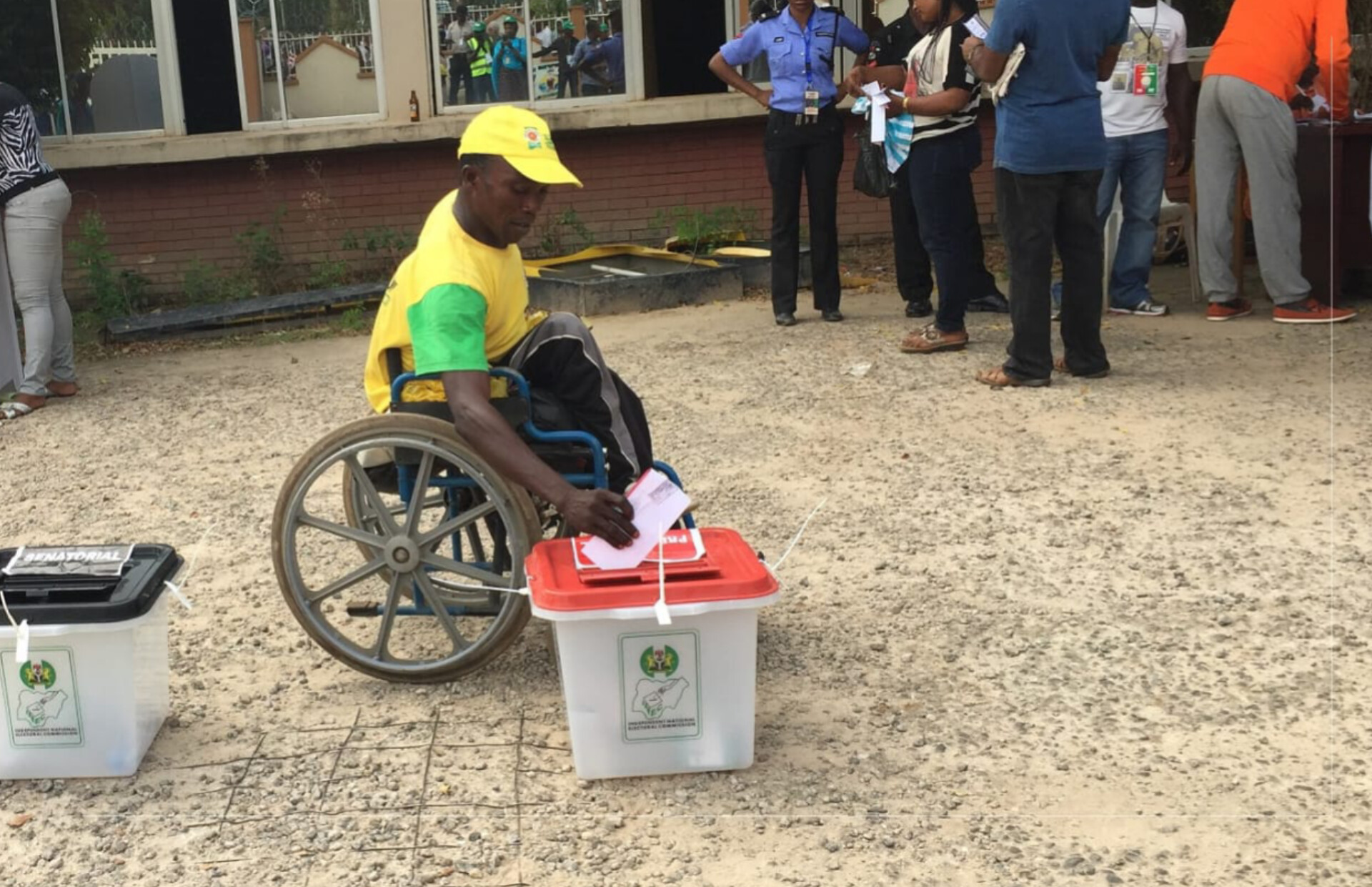
Persons with Disabilities (PWDs) in Nigeria have declared their readiness to move beyond voter participation and actively contest elective positions across the country as part of efforts to deepen inclusive democracy.
The declaration was made on Tuesday in Abuja during the launch of the “Able2Run: Electability Campaign,” organised by The All-Rights Foundation Africa with support from the European Union through its Support for Democratic Governance in Nigeria programme.
The initiative seeks to increase political representation for persons with disabilities and encourage them to seek elective offices at all levels of government.
Speaking at the event, the Chief Executive Officer of The All-Rights Foundation Africa, Jake Epelle, said persons with disabilities had long been denied meaningful participation in Nigeria’s political process despite their large population.
“It is important to underscore the fact that for too long, persons with disabilities have been agitating for the opportunity to participate in the electoral process. But we are moving beyond participation to being allowed to run for office,” he said.
Epelle argued that Nigeria’s democracy continued to exclude millions of persons with disabilities, claiming that their estimated population of about 35 million was larger than the number of votes secured by President Bola Ahmed Tinubu in the 2023 presidential election.
According to him, most political appointments given to persons with disabilities remained symbolic rather than impactful.
“We are tired of tokenism. More than 99 per cent of the positions we occupy are merely symbolic. We want opportunities to compete for elective positions, not just appointments,” he stated.
He also challenged political parties to demonstrate genuine commitment to disability inclusion by creating pathways for persons with disabilities to contest elections.
“All political parties must show clear commitment to inclusion. Tell us one agenda or manifesto that specifically creates opportunities for persons with disabilities to compete for elected positions,” Epelle said.
The disability rights advocate further urged persons with disabilities to actively participate in politics beyond supporting candidates.
“Participate to emerge, not just to support candidates,” he added.
Epelle, however, commended the Independent National Electoral Commission for its efforts toward promoting inclusive elections, noting that the commission had shown commitment through policies and frameworks designed to support accessibility and participation.
He also stressed the need for transparent and credible elections across the country.
“We want elections where the true winner emerges, elections free from insecurity and manipulation,” he said.
Also speaking, Senior Programme Manager at The Kukah Centre, Esrom Ajanya, described persons with disabilities as a major political constituency capable of influencing electoral outcomes if effectively mobilised.
Citing data from the World Health Organization, Ajanya said about 16 per cent of the global population lives with one form of disability or another, estimating Nigeria’s disability population at approximately 34.9 million people.
“This represents not only a significant demographic constituency, but also a powerful electoral force capable of influencing political outcomes and shaping governance at every level,” he noted.
Ajanya lamented the low representation of persons with disabilities in elective offices, revealing that a recent national study conducted by TAF Africa on political participation between 1999 and 2025 found that only four persons with disabilities occupied elective positions across federal, state and local government levels during the period.
According to him, the figure accounted for less than 0.1 per cent of elected offices nationwide, while no woman with disability held any elective office within the same period.
He added that more than 99 per cent of political positions occupied by persons with disabilities were appointive rather than elective, raising concerns about tokenism and limited political inclusion.
Ajanya explained that the political rights of persons with disabilities were guaranteed under the Discrimination Against Persons with Disabilities (Prohibition) Act, the Nigerian Constitution, and the United Nations Convention on the Rights of Persons with Disabilities.
Despite these legal protections, he identified several barriers hindering political participation by persons with disabilities, including inaccessible polling units, discriminatory attitudes, poverty, communication barriers and exclusion within political party structures.
He also raised concerns over the lack of disability-disaggregated electoral data.
Ajanya disclosed that TAF Africa, with support from the European Union, had launched a national mentorship and coaching programme aimed at supporting aspiring politicians with disabilities.
According to him, the programme would establish virtual political hubs across Nigeria’s six geopolitical zones and provide mentorship for at least 180 aspiring politicians with disabilities.
“Participants will receive training in leadership, strategic communication, campaign financing, voter mobilisation, political negotiation, media engagement and inclusive governance,” he said.
Ajanya called on political parties to adopt affirmative action measures and ensure their offices, campaigns, meetings and communication materials were accessible to persons with disabilities.
He also urged the Independent National Electoral Commission to strengthen disability inclusion guidelines and improve disability-disaggregated voter data.
“Nigeria cannot claim to be truly democratic while millions of citizens remain politically invisible. The time has come to move from symbolic inclusion to substantive representation,” he said.
Nigeria’s political landscape has historically recorded low representation of marginalised groups, with financial, structural and accessibility barriers limiting the participation of many aspiring candidates outside established political networks.
Although recent reforms have emphasised inclusion in governance, meaningful participation of persons with disabilities in elective politics has remained limited.
Join Inclusive News Network WhatsApp Community For Quick Access To News and Happenings Around You.