


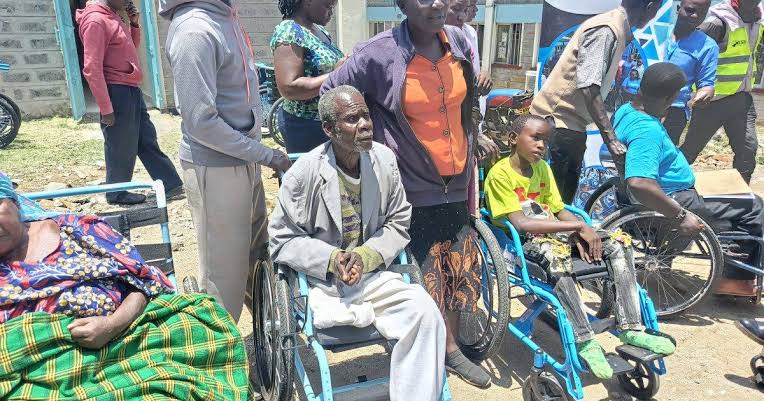
The Justice, Development and Peace Caritas Initiative (JDPCI), an agency of the Catholic Archdiocese of Abuja, has called on stakeholders to renew their commitment to promoting inclusion, dignity, equality and justice for persons with disabilities and other marginalised groups in Nigeria.
The Executive Director of JDPCI, Rev. Fr. Sebastian Sanni, made the call at the inauguration of the Bold Action for Advancing Disability Rights and Inclusive Development Project, a three-year initiative targeting selected states in Nigeria’s North Central region.
The project will be implemented in Benue and Plateau states, as well as the Federal Capital Territory (FCT), with a focus on addressing disability inclusion from a broader and more sustainable perspective.
Fr. Sanni said the initiative was designed to promote the rights, participation, dignity and inclusion of persons with disabilities while contributing to the development of systems that guarantee equal access and opportunities.
According to him, the project will strengthen disability-inclusive systems, improve access to essential services and opportunities, and support the meaningful participation of persons with disabilities in community development and decision-making processes.
“We see this project as a platform for partnership, collective action and sustainable change. At JDPCI, we remain firmly committed to the principles of human dignity, social justice, participation, equity and the common good,” he said.
Fr. Sanni noted that a society could not genuinely claim to be inclusive while persons with disabilities continued to face barriers to education, healthcare, livelihoods, employment, information, political participation, public infrastructure and other essential services.
He therefore called on government institutions, civil society organisations and development partners to see the project as a collective responsibility and strengthen efforts towards disability-inclusive development.
“We encourage government institutions to remain committed to implementing disability-inclusive policies and strengthening systems that protect the rights of persons with disabilities.
“To civil society organisations and development partners, we invite you to strengthen collaboration, knowledge sharing and joint advocacy.
“This is not merely the launching of a project. We are launching a renewed commitment to inclusion, dignity, equality and justice,” he said.
Also speaking, the Country Director of CBM, Mr Samuel Omoi, said persons with disabilities remained at the core of the organisation’s programmes.
Omoi, who was represented by CBM Finance Expert, Mr Emmanuel Abba, said the project was particularly focused on improving the lives and rights of persons with disabilities across the three target locations.
He noted that CBM was also supporting other disability-focused programmes, including the Disability Rights Advocacy Project for Inclusive Development (D-RAPID) in Delta State.
According to him, D-RAPID has components focusing on national-level disability-inclusive coordination, as well as disability-inclusive programming and implementation in Delta and Benue states.
Omoi said the roundtable discussions under the new project would provide an opportunity for stakeholders to examine the challenges affecting disability inclusion in the FCT, particularly issues surrounding legislation, implementation and enforcement.
He expressed optimism that the discussions would produce practical recommendations to strengthen support for persons with disabilities and improve disability-inclusive development.
In his remarks, the Deputy Commandant of Corps, Nigeria Security and Civil Defence Corps (NSCDC), FCT Command, Mr Bitrus Ameloko, said the Corps was aligned with the objectives of the project and committed to supporting disability rights enforcement.
Represented by an Assistant Commandant of Corps, Mrs Obi Ogechi, Ameloko said the NSCDC was committed to enforcing the Discrimination Against Persons with Disabilities (Prohibition) Act 2018.
He disclosed that the Corps had established Persons with Disabilities Desks across the 36 states of the federation and the FCT to ensure that issues affecting persons with disabilities received prompt attention.
Ameloko also said no fewer than 100 NSCDC officers had been trained in sign language, adding that the initiative had enhanced the Corps’ ability to gather intelligence and respond to issues affecting persons with disabilities.
“We are here to support persons with disabilities and to enforce the Discrimination Against Persons with Disabilities (Prohibition) Act 2018.
“We are ready to partner with every organisation that is in tandem with this objective and the objectives of JDPCI. As the project rolls out, we are here to support it,” he said.
Join Inclusive News Network WhatsApp Community For Quick Access To News and Happenings Around You.