


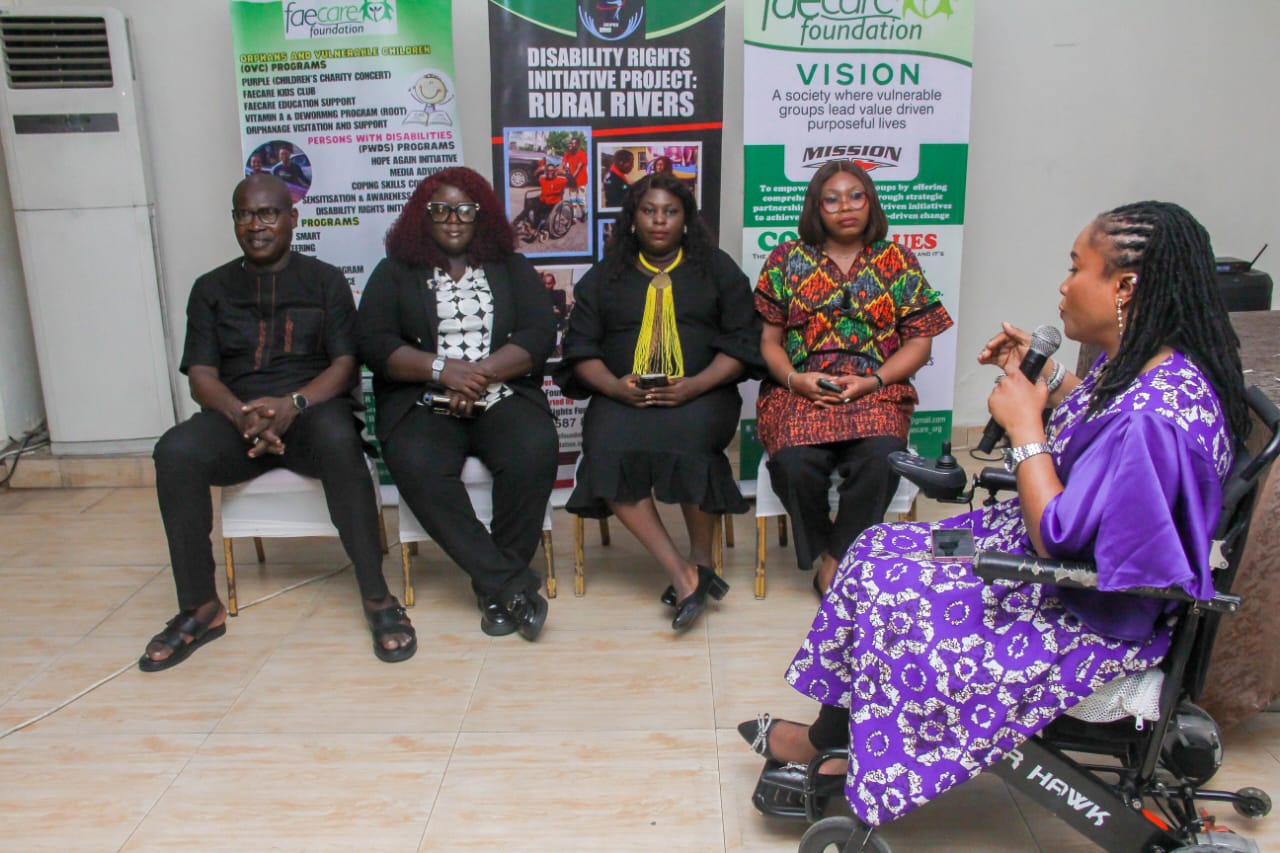
Stakeholders in Rivers State have renewed calls for the passage of a comprehensive disability rights law following a high-level roundtable held in Port Harcourt, an engagement widely described as a significant step toward inclusive governance and protection of the rights of persons with disabilities.
The roundtable, organized by the Freky Andrew-Essien Care Foundation, also known as FAECARE Foundation, with support from the Disability Rights Fund under the Disability Rights Initiative Project: Rural Rivers, brought together government officials, civil society organizations, development partners, and organizations of persons with disabilities to develop a practical roadmap for advancing disability inclusion in the state.
Participants at the meeting expressed concern that despite the existence of national legislation protecting the rights of persons with disabilities, many individuals in Rivers State continue to face systemic barriers in accessing education, healthcare services, employment opportunities, and public infrastructure.
Speaking during the engagement, the Executive Director of FAECARE Foundation, Ambassador Ndifreke Andrew-Essien, emphasized that the challenges faced by persons with disabilities are not caused by disability itself, but by systems that have not been deliberately designed to accommodate everyone. He stressed the importance of shifting perspectives from charity-based responses to rights-based and development-focused approaches to disability inclusion.
Throughout the presentations and panel discussions, stakeholders underscored the need for structured and enforceable solutions backed by law and institutional accountability. Key issues highlighted included the inaccessibility of public buildings and transportation systems, limited opportunities for inclusive education, barriers within the healthcare system, and persistent discrimination in employment.
A major outcome of the roundtable was a collective agreement on the urgent need to move the drafted Rivers State Disability Rights Bill beyond the proposal stage. Participants noted that the passage of the law would provide a legal framework to guarantee accessibility, protect rights, and ensure equal participation of persons with disabilities across all sectors of society.
In addition to legal reform, stakeholders called for the establishment of a state-level institutional mechanism, such as a Disability Commission or coordinating body, to oversee implementation, monitor compliance, and ensure accountability within government institutions.
The engagement also emphasized the importance of mainstreaming disability inclusion across key sectors, including education, health, infrastructure, and employment. Participants noted that without integrating disability inclusion into government planning and budgeting processes, efforts to promote accessibility and equality would remain fragmented and ineffective.
Another key focus of the discussions was the need to ensure that persons with disabilities are actively involved in decision-making processes. Stakeholders stressed that policies and programmes are more effective when informed by the lived experiences of those directly affected.
Institutional representatives present at the meeting also expressed commitments toward advancing disability rights in the state. The Nigerian Security and Civil Defence Corps highlighted the existence of a Disability Rights Help Desk to support reporting and redress, while officials from the Ministry of Justice indicated their readiness to support the enforcement of disability rights through appropriate legal channels. The Ministry of Social Welfare, through the Permanent Secretary overseeing disability affairs, reaffirmed its commitment to promoting the rights and welfare of persons with disabilities in Rivers State.
Looking ahead, stakeholders outlined several next steps aimed at accelerating progress. These include engaging key political actors to drive legislative action, establishing a technical working group to support the advancement of the drafted disability bill, and sustaining advocacy through continued stakeholder engagement and media involvement. Participants also acknowledged that while political instability remains a challenge, preparedness and sustained advocacy will be critical to achieving meaningful reforms.
The roundtable concluded with a strong call for action and sustained collaboration among all stakeholders. For many participants, the engagement represents more than a policy discussion; it signals growing momentum toward building a Rivers State where disability does not limit opportunity, public systems are designed to include everyone, and rights are protected not only in principle but in practice.
Stakeholders ended the engagement with a clear message: no more delays and no more barriers—an inclusive Rivers State is possible through decisive legislative and institutional action.
Join Inclusive News Network WhatsApp Community For Quick Access To News and Happenings Around You.