


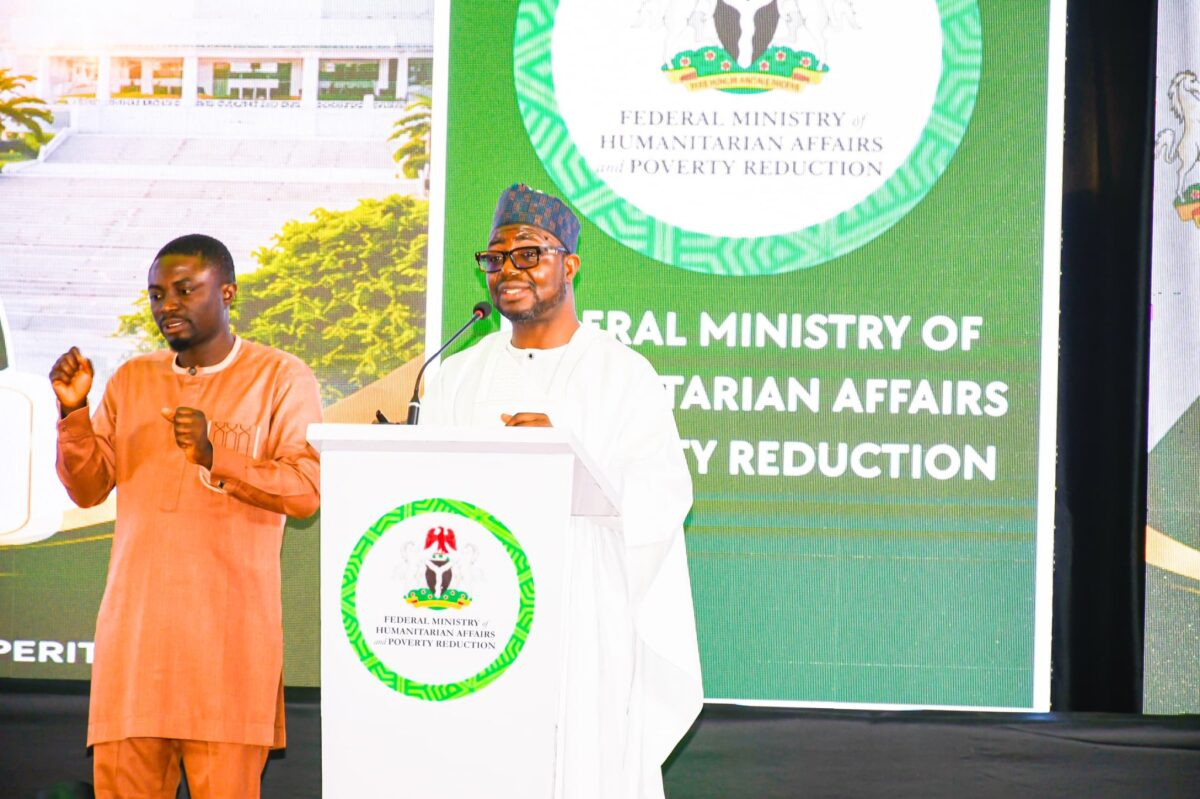
The Federal Government has launched the $1 billion Household Prosperity and Economic Social Protection Project (HOPE-SP) as part of efforts to transform humanitarian assistance from short-term palliatives into sustainable pathways to recovery, empowerment and self-reliance.
The initiative was unveiled on Wednesday by the Ministry of Humanitarian Affairs and Poverty Reduction at the Banquet Hall of the State House, Abuja, under the theme, “From Palliatives to Pathways.”
The ministry said HOPE-SP is designed to strengthen Nigeria’s social protection and humanitarian response architecture by improving the identification, targeting and support of vulnerable households, while promoting better coordination, accountability and measurable outcomes.
Speaking as Special Guest of Honour, First Lady Oluremi Tinubu commended the Minister of Humanitarian Affairs and Poverty Reduction, Bernard Doro, and his team for pursuing reforms aimed at moving humanitarian interventions beyond temporary relief.
She said the initiatives would improve the identification and targeting of vulnerable households, strengthen coordination among humanitarian and poverty-reduction programmes, provide shock-responsive assistance and promote accountability.
“The initiatives are designed to improve the identification, targeting and support of vulnerable households, strengthen coordination across humanitarian and poverty-reduction programmes, provide shock-responsive assistance, and promote accountability and measurable outcomes,” she said.
Doro described the launch as a strategic shift in the government’s approach to humanitarian intervention, placing vulnerable households at the centre of government support rather than treating programmes as isolated interventions.
According to him, the reform is intended to address fragmentation, duplication and the existence of multiple, uncoordinated registries across intervention programmes.
He said the government would establish a unified national architecture connecting identification, needs assessment, targeted intervention, protection, empowerment, poverty graduation and sustainable economic growth.
A major component of the reform, he explained, is the One Humanitarian, One Poverty Response System (OHOPRS), which will integrate humanitarian response, social protection and poverty-reduction interventions into a coordinated national framework.
Doro said the system would be supported by unified registries, digital delivery platforms, improved financing mechanisms, stronger institutions, accountability measures and real-time intelligence to ensure that assistance reaches the people who need it most.
Other initiatives unveiled at the event included the Emergency Shock-Responsive Cash Transfer, the FMHAPR Ministerial Blueprint and the Humanitarian First Magazine, which the ministry said would document beneficiaries’ experiences and the impact of government interventions.
The Permanent Secretary of the ministry, Olubunmi Olusanya, said the initiatives would further strengthen coordination and accountability in the delivery of humanitarian and poverty-reduction programmes.
“The ultimate measure of success would be the tangible difference made in the lives of vulnerable Nigerians,” Olusanya said.
Goodwill messages were delivered by Borno State Governor Babagana Zulum on behalf of governors and sub-national governments; Minister of Budget and Economic Planning, Abubakar Bagudu; former Minister of State for Humanitarian Affairs, Yusuf Tanko Sununu; the European Union; the World Bank; and other international development partners.
The stakeholders commended the Federal Government’s efforts to strengthen Nigeria’s social protection and humanitarian response systems.
The event also featured a cultural performance by the Irigwe New Wave Dance Troupe from Plateau State.
Join Inclusive News Network WhatsApp Community For Quick Access To News and Happenings Around You.