


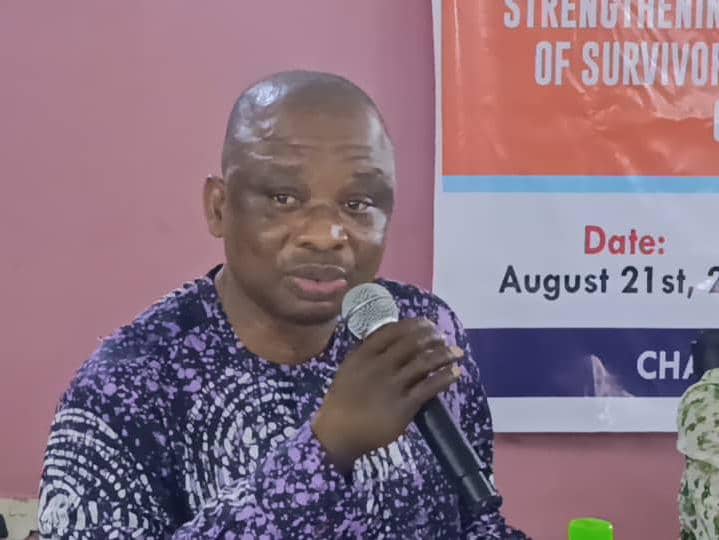
The Abia State Disability Commission has called for the deliberate and comprehensive inclusion of women and girls with disabilities in the implementation of the newly enacted Abia State Centre for Rehabilitation of Survivors of Rape, Defilement, Domestic Violence and Any Form of Human Trafficking Law, 2026.
Chairman of the Commission, Dr. David Anyaele, made the call on Thursday in Umuahia during a one-day stakeholder engagement on strengthening the operationalisation of the law.
The engagement was organised by the African Centre for Human Advancement and Resource Support (CHARS-Africa) with support from the Urgent Action Fund-Africa (UAF-Africa).
Dr. Anyaele cautioned that the existence of a legal framework alone would not guarantee adequate protection for persons with disabilities unless the systems established under the law were deliberately designed to eliminate physical, communication and institutional barriers.
He noted that women and girls with disabilities face heightened risks of sexual and gender-based violence, with their vulnerability often compounded by dependence on caregivers, communication barriers, limited privacy, inaccessible reporting mechanisms, social isolation, stigma and difficulties in seeking immediate assistance.
According to him, the effectiveness of the new law would depend largely on whether survivors with disabilities could access rehabilitation, justice and support services without encountering barriers.
“A rehabilitation centre may exist, but if a wheelchair user cannot enter the building, it is not inclusive. If a Deaf survivor cannot communicate because there is no sign language interpreter, justice may be denied,” he said.
The Commission Chairman therefore urged stakeholders to examine the operational framework of the law through a disability-inclusion lens, stressing the need to make all rehabilitation facilities physically accessible.
He also called for information and communication to be provided in accessible formats for blind persons and people with intellectual disabilities, while personnel working within the system should receive adequate training on disability inclusion.
Dr. Anyaele further advocated the meaningful participation of women with disabilities and their representative organisations in the monitoring and implementation of the law.
“The success of this Law should not be measured only by the establishment of structures, but by whether every survivor, with or without disability, can access protection, rehabilitation, justice and support with dignity,” he said.
The Commission Chairman commended the Abia State Government for establishing what he described as a sustainable pathway for the rehabilitation and reintegration of survivors of gender-based violence.
He particularly appreciated the Wife of the Governor, Lady Priscilla Chidinma Otti, for championing the legislation, as well as the Abia State House of Assembly for passing the Bill and Governor Dr. Alex C. Otti, OFR, for assenting to it.
“The message is clear: survivors must not be abandoned, and all hope is not lost,” he added.
Earlier, the Executive Director of CHARS-Africa, Barrister Amaka Biachi, disclosed that there was a significant awareness gap surrounding the new legislation.
Biachi revealed that only about five per cent of stakeholders reached during preliminary consultations were aware of the existence of the law.
She described the finding as an indication of the scale of work required to transform the legislation from a legal document into an effective, survivor-centred system of protection and rehabilitation.
According to her, the real impact of the law would ultimately depend on how effectively its provisions were translated into practical measures and accessible services for survivors.
The stakeholder engagement brought together representatives of government ministries, departments and agencies, traditional institutions, labour, health and social service providers, civil society organisations and community stakeholders.
Discussions at the engagement focused on strategies for translating the 2026 law into an effective framework for the protection, rehabilitation and reintegration of survivors of rape, defilement, domestic violence and human trafficking, with particular attention to the rights and needs of persons with disabilities.
Join Inclusive News Network WhatsApp Community For Quick Access To News and Happenings Around You.