


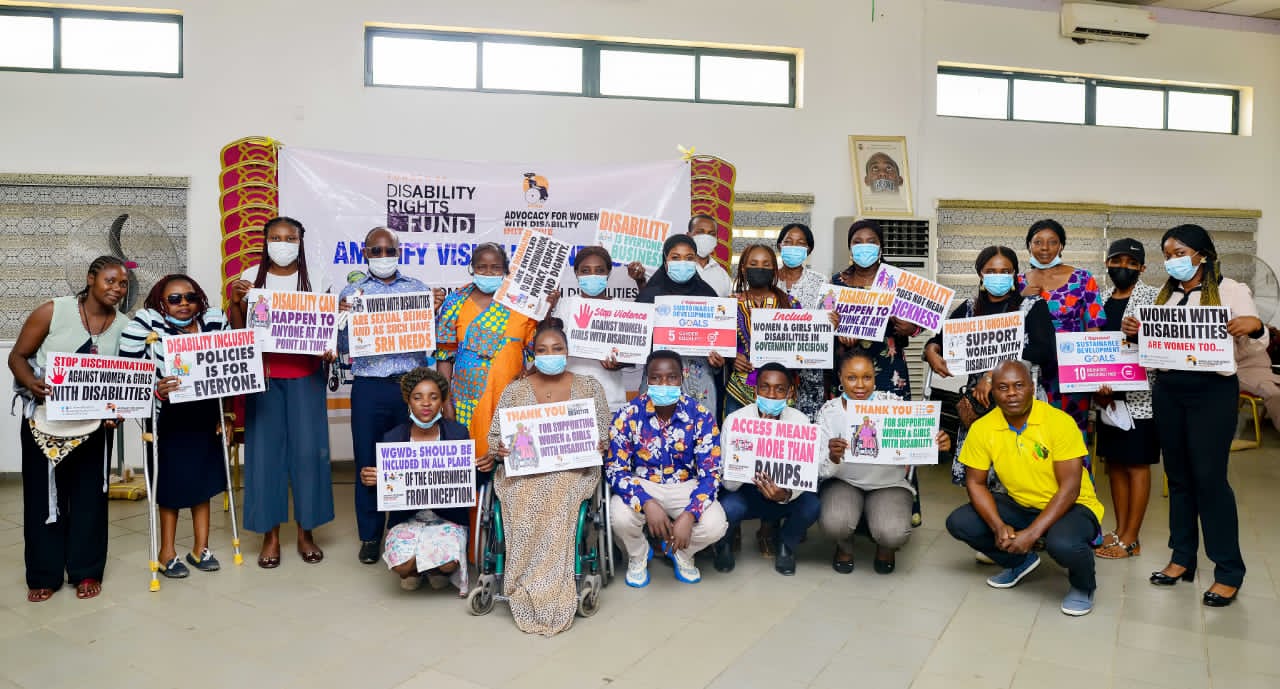
Advocacy For Women With Disability Initiative (AWWDI) has called for inclusion of Persons with Disabilities among drafters of the National Policy on Sexual and Reproductive Health and Rights (SRHR).
Executive Director of AWWDI, Patience Ogolo made the call at a capacity building workshop held on 24 February for Health workers and Media practitioners in relation to the National policy on SRHR and Discrimination Against Persons With Disabilities Prohibition Act, 2018 in line with international best practices (UNCRPD and SDGs). The event was organized in collaboration with the Disability Rights Fund.

AWWDI Executive Director, Patience Ogolo
In her opening remarks, Ogolo stressed the need for change of societal myths and perception of society towards women with disabilities, citing that those with disability face sexual harassments such as rape as do their non-disabled counterparts.
She pointed out the need for the inclusion of People with Disabilities (PWDs) among drafters of the National Policy on SRHR in order to ensure an inclusive and comprehensive policy which caters to the needs of this class of persons.
Attendance at the workshop comprised different public agencies, popular media stations including TVC news, The Guardian etc. Medical experts, non-profit organizations like The National Orientation Agency (NOA), Disability Rights Fund, The Federal Ministry of Health and FRCN also made the list.
The Director General (DG), National Orientation Agency, Dr. Garuba Abari was represented at the workshop by Mrs Grace Mama. Speaking on the laudable provisions of the Discrimination Against Persons with Disability Prohibition Act, 2018, Mama noted that PWDs are yet to access full benefits of the Act due to lack of awareness, particularly in the rural areas. In this light, she stressed the Agency’s commitment to creating awareness through its various awareness programs.
According to her, these programs are advanced by different Chief Orientation Officers in the 774 Local Government Areas of the country.
She equally affirmed the Agency’s commitment to collaborating with Disability Associations such as AWWDI for public enlightenment on the rights of persons with disabilities in other to foster the effective implementation of the Act.
The Federal Radio Corporation of Nigeria, FRCN, in a reassuring affirmation to AWWDI through its representative noted that the corporation would continue to be involved in advancing the cause of women with disabilities on all fronts.
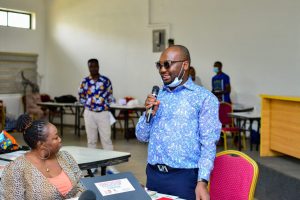
DRF program officer, Theophilus Odaudu
Also speaking at the workshop was Mr. Theophilus Odaudu of the Disability Rights Fund – a nonprofit organization that supports advocacy of disability rights.
Mr. Odaudu recapped the foremost idea that women with disability should always be included in all sectors of society and formulation of policies that affect them.
Similarly, Mrs. Adaeze Stella Ike of the Federal Ministry of Health in her presentation, noted that disability is never hoped for, and as such, is not anyone’s fault. She also pointed that different kinds of disability needs different types of adaptation. Stella stressed on inclusion and modification of public structures to suit accessibility needs of PWDs.
She encouraged Health workers to prioritize the needs of PWDs and attend swiftly to them in their respective hospitals, meanwhile respecting their individual decisions and privacy.
Of particular concern to Stella was the current transport system in Nigeria which is considered non-friendly to PWDs. She observed that transportation, especially in the rural areas is not inclusive and in most cases deter people with disabilities from going to the hospital.
Recapping on what the previous speakers noted, Mrs. Stella demanded a radical shift in the policy drafting process, advocating that the roundtable for each policy drafting should always include PWDs.
In terms of sexual violence, Stella was quick to criticize the aged-long myth of degradation placed on women and girls with disabilities – namely, that they can not pursue justice when raped. She noted from statistics that 40% to 60% of women with disability experience sexual violence. Hence, she called on the health workers to change their attitudes towards PWD rape victims and attend to them as they would other rape victims.
Conclusively, she stressed the need for hospitals to have robust supports such as Interpreters and guides for PWDs. She also encouraged parents of children with disabilities to engage them in sexual education from a tender age.