


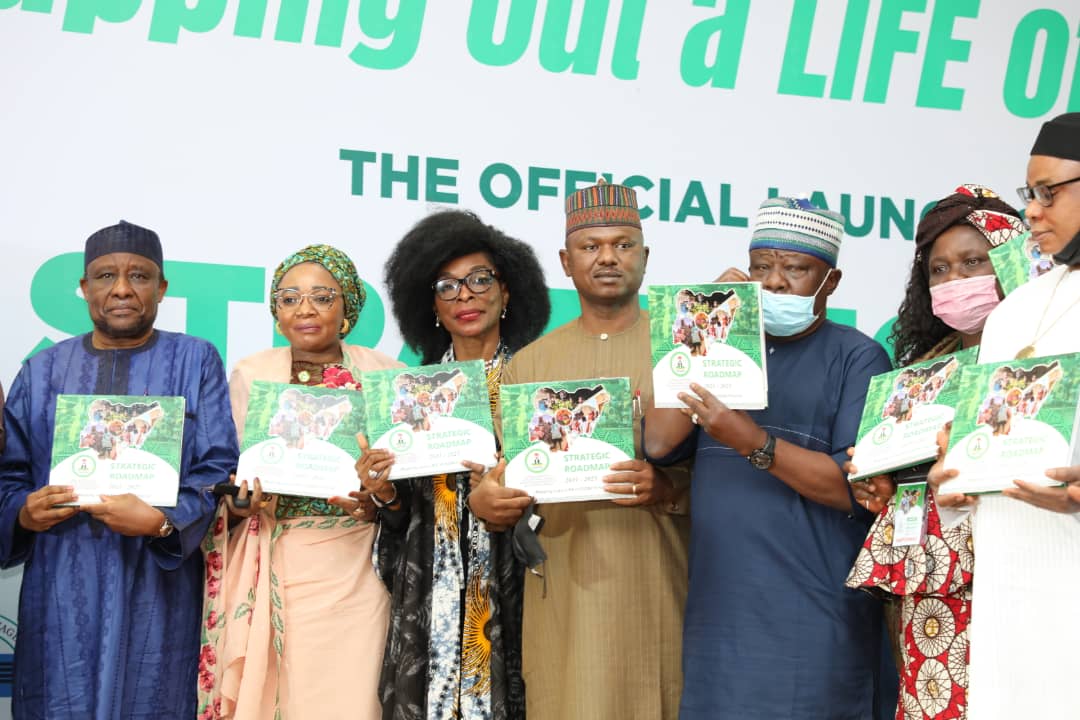
The federal government, Monday, launched a road map it developed to sustain effective humanitarian interventions in the country.
The five-year strategic roadmap,developed by the Federal Ministry of Humanitarian Affairs, Disaster Management and Social Development, and tagged:”Mapping out a life of dignity for all”,introduced implementation, monitoring, evaluation, review and reporting mechanisms that will be deployed to ensure effective results delivery.
Speaking at the Launch of the ministry’s Strategic Roadmap 2021 – 2025, the minister, Sadiya Umar Farouq, explained that the development was in fulfilment of President Muhammadu Buhari’s directive when she was appointed following to that effect.
“On 21st August 2019, when President Muhammadu Buhari announced the creation of this Ministry, along with my appointment as the Minister, the President’s mandate was clear and unequivocal: to ”develop humanitarian policies and provide effective coordination of national and international humanitarian interventions; ensure strategic disaster mitigation, preparedness and response; and manage the formulation and implementation of fair focused social inclusion and protection programmes in Nigeria”,she said.
She added:”To effectively execute the Presidential directives, we recognized early enough that it is imperative to brainstorm and develop a strategic roadmap that will serve as a guiding light on our path towards fulfilling the ministerial mandate.
“The roadmap we are launching today is the end product of the cohesive analysis of the valuable insights, feedback and inputs received from the Ministry’s departments and agencies.
“This Strategic Roadmap is aptly themed, “mapping out a life of dignity for all”, in line with the Ministry’s onerous task of effectively discharging responsibilities that are pivotal to the economy of the nation and the well-being of the citizenry.”
She explained that,”In formulating the seven key strategic focal points of the Strategic Roadmap, we thoroughly analyzed the nine key priority areas of President Buhari’s agenda, the Economic Recovery and Growth Plan (ERGP), and the National Development Plan that was recently launched by Mr. President on Wednesday, 22nd December 2021.”
” The alignment of the ministry’ strategic pillars with these operative national plans ensures that the ministry and its stakeholders are working in the right direction towards championing the federal government’s developmental stride.
“The roadmap also introduced implementation, monitoring, evaluation, review and reporting mechanisms that will be deployed to ensure effective results delivery.
“These key performance indicators and performance tracking instruments will enable the Ministry to monitor its efficiency and measure implementation of the strategic roadmap over the five-year period 2021 – 2025.
” In addition, the full implementation of the strategic thrusts and the roadmap, while consolidating the priority areas of the Federal Government, will also guide us towards achieving the mandate of the ministry, improving the lives of vulnerable Nigerians and mapping out a life of dignity for all,”she added.
The minister said seven “Strategic Pillars” identified for the ministry following the roadmap were:”Strengthening Policies and Institutional Framework;Building Evidence-Based Systems for Transparency and Accountability;
Enhancing Programme Delivery Through Effective Monitoring and Evaluation Mechanisms; Optimizing Funding and Resourcing Opportunities; Strategic Partnerships, Collaborations and Disability Inclusion; Implementation of a Robust Humanitarian Coordination System for Improved Communication and Governance; and Mainstreaming of the Sustainable Development Goals (SDGs) and Integration of Social Initiatives and Investment Programmes.”
“We have provided detailed information on each of the strategic pillars – providing the background and objective, highlighting the key action plans, and identifying the key stakeholders. The roadmap has also clearly demonstrated the activities that must be carried out under the planning, implementation, coordination, monitoring and evaluation phases of each strategy. Our stakeholders have been carefully mapped out and grouped into clusters and the interwoven relationship between the clusters have been clearly delineated in the roadmap.
“The most critical aspect of the Strategic Roadmap is in the implementation, and I assure everyone gathered here today of the ministry’s firm resolve and commitment to providing all the necessary support and resources required to execute the strategies and actualize its founding vision. We must not allow this Strategic Roadmap to fail, and I call on everyone to join hands with us to ensure its success.
“It is expected that after the formal launch today, every policy, programme, initiatives and activities of our units, departments and agencies will be aligned with the Strategic Roadmap.
“Quarterly strategic review meetings will also be held, in line with the set targets and corresponding timelines across all units, departments and agencies supervised by the ministry,”she said.
Farouq explained that, ”This Strategic Roadmap is a product of widespread consultation and extensive deliberations within and outside the ministry and its agencies.”
According to Farouq,”From managing disasters, to responding to humanitarian issues and implementing social development programmes and interventions, the Ministry is well positioned to proactively deal with myriad issues, such as natural and man-made disasters, social imbalance, inadequate food provision and inequitable distribution of social amenities amongst the citizenry.”
“Under the guidance and effective coordination of the Ministry, our agencies are collectively meeting the needs of our people, and through our National Social Investment Programmes (NSIP), we have used the machinery of our cluster programmes to bolster the productivity of our men, women and the youths, and also improve their overall economic status,”she noted.
The minister recalled that,”The National Home-Grown School Feeding Programme, for instance, has had a major impact on school children through a significant increase in school enrolment and attendance, along with a corresponding improvement in the health of pupils credited to the nutritious meal that is now made available to them.”
” In addition, our young people are provided access to capital, labour and training through the N-Power and the Government Enterprise and Empowerment Programme (GEEP) scheme, along with targeted cash transfer to poor and vulnerable households under the Conditional Cash Transfer (CCT), amongst other NSIP interventions.
“Collectively, these programmes are playing a significant role towards the attainment of President Buhari’s commitment to lift 100 million Nigerians across the country out of poverty by the year 2030.
“Since its creation in August 2019, the FMHADMSD has steadily expanded through the decidedly deliberate addition of issue – specific commissions. For instance, in line with the Discrimination Against Persons with Disabilities (Prohibition) Act 2019, we have successfully ensured the seamless take-off and constitution of the Board of the National Commission for Persons with Disabilities (NCPWD) to ensure that Persons Living with Disabilities are fully represented and catered for, and are also able to actively participate in all matters affecting them to enable them live a life of dignity,”she said.
She recalled President Buhari’s humanitarian interventions through the ministry thus:”To effectively cater for the worrying number of out-of-school children in Nigeria, President Buhari recently launched the Alternate School Programme (ASP) to ensure that every out-of-school child in Nigeria has access to quality basic education, irrespective of their social, cultural or economic circumstance. We are fully committed to providing opportunities for out-of-school children to develop life supporting skills, from vocational and entrepreneurship training, for effective functioning in the society.
“Our elderly people aged 70 years and above are also not left out of our intervention initiatives, as President Buhari has given effect to the National Senior Citizens Centre Act, 2017, via the Presidential approval granted for the take-off of the National Senior Citizens Centre and the constitution of its 12-member Board. Through this center, we are able to map out a life of dignity and cater for the specific needs of our senior citizens who have spent their active years in the service of our dear country.”
Vanguard