


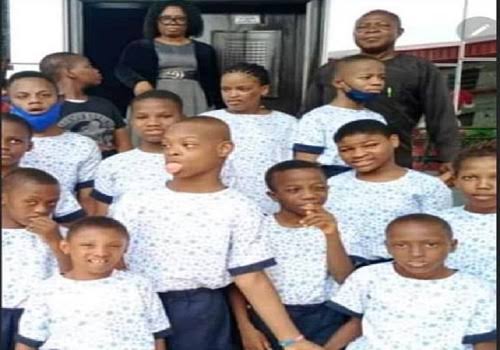
From cradle to grave, there is always a deep craving in every person to be appreciated, valued and treated with dignity. These human expectations do not, in any way, exclude people living with down syndrome and other special needs individuals in the society, writes DUMA EDWARD-DIBIANA
How do people feel when they are deprived or prevented from participating in certain things because of their colour, race, tribe, social status, religion or other considerations? How do you feel when you are out rightly sidelined in what you know you are qualified for due to one lame excuse? That feeling of rejection, denigration or ghosting as if one doesn’t exist, drains one of one’s self-belief and self-esteem.
It’s a horrendous feeling. That’s apparently how most children and people living with Down syndrome and others with special needs feel most times when they are systematically denied of their fundamental human rights by society, just because of their peculiarities.
What’s Down Syndrome?
Moving to Canada is The best choice for you and your family!
Canada Immigration Express
What do you know about the genetic condition referred to as Down Syndrome (DS)? A simple explanation would suffice for a better understanding. All humankind is born with 46 chromosomes. Twenty-three from the father and 23 from the mother and they come in pairs. But for people living with DS, have three (3) copies of the 21st chromosome, instead of the usual two (2) copies. So, instead of the normal 46, they have 47, which is an anomaly. And that anomaly manifests in diverse forms that impact them in ways that affect their development abilities, physically and mentally.
Chromosomes are bundles of genes that the body relies on to function optimally. But that can only happen when the numbers are equal. With DS, this extra-chromosome present in their makeup leads to a wide range of issues, from mild to severe intellectual disability and sometimes, some medical conditions. Down syndrome is not a disease. It is a congenital condition. People live with it, but do not suffer from it as a disease. It is only a genetic disorder and it’s not contagious.
While it’s a medical fact that DS cannot be cured, it is a lifelong condition that can be managed, with proper attention and early intervention, medically and useful therapies. Every person born with DS is different and has a different mix and severity of the condition. It affects people differently. They may take longer time to reach important milestones such as walking, talking and developing social skills. They will continue to learn and pick up new skills their whole life. Their mental abilities vary. Most people with DS have moderate issues with thinking, reasoning, and prioritising, among other things. Some of them would grow up to live almost entirely on their own; while others may need more help taking care of themselves.
Today is World Down Syndrome Day, a day set aside to celebrate people living with DS the world over. It is a global awareness/sensitisation day officially observed by the United Nations (UN) since 2012. Why March 21? March is the third month of the year representing the three chromosomes and 21 represents the 21st chromosome where this disorder occurs. Every year this day, millions of people living with DS, their families, advocates, caregivers and friends, create awareness and bring to the fore burning issues concerning these special people.
The theme of this year’s World Down Syndrome Day is “Inclusion Means….” What is inclusion and what does it mean to be included. What is your personal take on what inclusion means? So, what does inclusion mean to you as a person? It’s good to know so we can learn, unlearn and relearn.
What does it mean to be included?
Inclusion means to carry everyone along regardless of the person’s condition. If you are included, you can participate in every meaningful activity everyone else is involved in without hindrances or discrimination. You can go to school and expect to be received like any other child and have access to facilities in the school that would make learning easier and more conducive as regards your special needs.
In daily lives, at the work place, market, school, community, recreation parks and worship centres, subtle and/or outright discrimination of people with DS and other special needs/disabilities are witnessed. The United Nations created an agreement called “The Convention on the Rights of Persons with Disabilities (CRPD).” The CRPD maintains that people with disabilities should have “full and effective participation and inclusion in the society.” So, why are many people with DS and other disabilities not fully included in everyday activities in our communities?
So many reasons have cropped up as why these rare gems are not included in the scheme of things. Some of the reasons are that to run an inclusive system is very expensive, lack of resources, manpower and that many people do not understand what inclusion means and how to be inclusive.
Why some of the above mentioned reasons may be true, they are not good enough to deprive fellow humans of their rights to live a more fulfilled life, like every other being. A fact it is that the opposite of inclusion is exclusion. And if the society, as a community, office, school, church or mosque, can exclude people with DS and other special needs/disabilities, then it means society knows what inclusion means; just that people don’t want to act on it for obvious reasons (their conditions).
For inclusion to thrive, there must be a mind shift! An attitudinal change! The society must understand that it is not their fault that they are different and that it could have been anyone else. Your creed, gender, religion, tribe, social status, race notwithstanding, shouldn’t be a condition for true inclusion.
The society is bedeviled with prejudice, stigmatisation and discrimination of people living with DS and other special needs. And all these stem from ignorance and lack of understanding. Until empathy replaces differences, and diversity, which is the ability to regard another and imagine life from a broader perspective, inclusion will remain a mirage. Inclusion is also inevitable in the education sector because it addresses and responds to the diverse needs of learners. It removes any barrier to learning. The question is: Are children living with DS and other special needs really included in schools that claim to run inclusive system?
Do they have equal rights and access to curricular and extra-curricular activities vis-a-vis their neurotypical mates? These questions are begging for answers. There must be an attitudinal change for inclusion to gain the needed ground. So, governments at all levels and stakeholders must truly and sincerely embrace that pattern of education that modifies/adjusts classroom practices meant for the ‘normal’ child to accommodate the peculiar needs of a child with Down syndrome. That pattern of education that doesn’t discriminate, but rather makes room for people living with DS to develop and learn at their own paces and abilities as their unique conditions would allow.
That pattern of education that teaches children from a tender age about equality, diversity and respect for others. That pattern of education that assists these people to meet their peculiarities and maximise their potential. That pattern of education is called inclusive education! Inclusive education should be harped to enable children with DS and other special needs soar and break previously seen and unseen barriers. True inclusion will always inspire hope and belief.
For most children living with DS and special educational needs, inclusion is often experienced as a painful form of exclusion. They should learn alongside their peers and given every opportunity to form meaningful friendships devoid of adult interference.
Inclusive education drives the much-needed enlightenment home because it allows people with DS to mingle, socialise and showcase their strength and weaknesses. Their peers see them for who they really are and make efforts to unconditionally accept or reject them as they would do to other children without these challenges. To foster inclusion, every member of the school community must make efforts to model behaviours that respect and accept individual differences. Children with DS deserve warmth and friendship. So, it is important for all hands to be on deck for increased sensitisation and awareness for a wider outreach because increased awareness and sensitisation will lead to enhanced inclusion; and a better society.
Edward-Dibina is a Down Syndrome advocate