


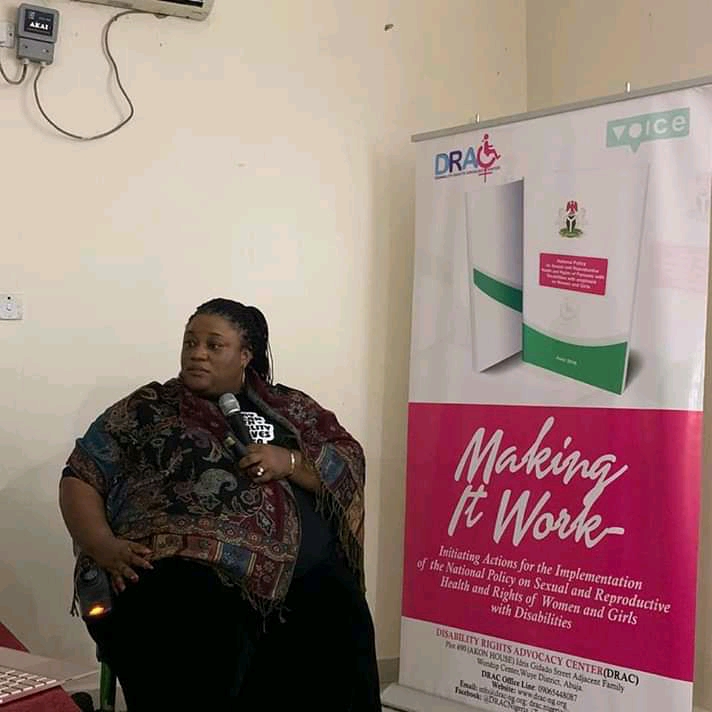
Disability Rights Advocacy Center (DRAC) on 24th -25th February, 2020 organized a two-day training of media practitioners on Disability and Sexual and Reproductive Health and Rights. The training was designed to improve the knowledge of media practitioners on Disability and SRHR, enhance their knowledge on the National Policy on SRHR of persons with disabilities with emphasis on women and girls with disabilities (WGWDs) and to identify and enhance the role of media in promoting SRHR of persons with disabilities (PWDs).
The Executive Director, DRAC, Dr. Irene Ojiugo Patrick-Ogbogu who is also an expert in the field of SRHR, in her opening remarks said that as an organization committed to advocating for the rights of persons with disabilities, DRAC observed that persons with disabilities continue to experience challenges in the area of their Sexual and Reproductive Health Rights, with Women and Girls with disabilities being most affected.
She explained that although persons with disabilities have the same sexual and reproductive health (SRH) needs as non-disabled persons, however, due to their disability, they experience barriers such as communication barriers, ignorance of service providers, societal attitude, inadequate capacity of service providers to manage clients with disabilities, etc which combine to deny them access to basic reproductive health services.
Speaking further, she explained that strengthening the capacity of the media, specifically On Air Personalities, columnists and bloggers, on disability inclusion and SRHR of PWDs/WGWDs was a deliberate decision in view of the role of the media in shaping and influencing public opinion and perception on important issues such as disability rights. She expressed confidence that this would result in an amplification of the voices of persons with disabilities and ultimately lead to changes in how they access services, as the training will provide the requisite knowledge of disability inclusion for the media practitioners to be the mouthpiece of the persons with disabilities, hold government and the service providers accountable to ensure that SRH services are provided in a disability inclusive manner.
She went on to give a brief background of the National Policy on SRHR of PWDs with emphasis on WGWDs. A policy initiated and jointly developed by DRAC and the Federal Ministry of Health and a host of stakeholders, endorsed by the Honourable Minister of Health and approved by the National Council on Health making it a policy of the Federal Government. DRAC also supported the development of a costed 5-year strategic plan as a first step towards its operationalization. She appealed to the media to monitor the implementation of the policy and raise awareness on its existence to empower persons with disabilities to effectively advocate for access to SRHR at all levels.
The participants who are media practitioners from electronic, print and social media thoroughly enjoyed the training, tagging it as the best training they had ever had, as innovative methodologies, techniques and interactive exercises were used to pass the message across. Topics explored include: Overview of Disability Inclusion, Gender and Disability, Sexuality/Sexual health and Reproductive rights, Legal frameworks on disability rights.
Dr. Irene tasked the participants to always use empowering and positive images and terminology in portraying / referring to persons with disabilities in their reportage, as a sure means of eliminating disability-related stigmatization and discrimination.
The participants made recommendations on how reportage in the area of disability can be improved and how best the media can carry out investigative reports on rights violations.
The 2-day training of media practitioners is part of the Making It Work project, a project designed to promote the implementation of the National Policy on SRHR of PWDs with emphasis on WGWDs in the FCT. The project is supported by Voice.
Source: Qualitative Magazine