


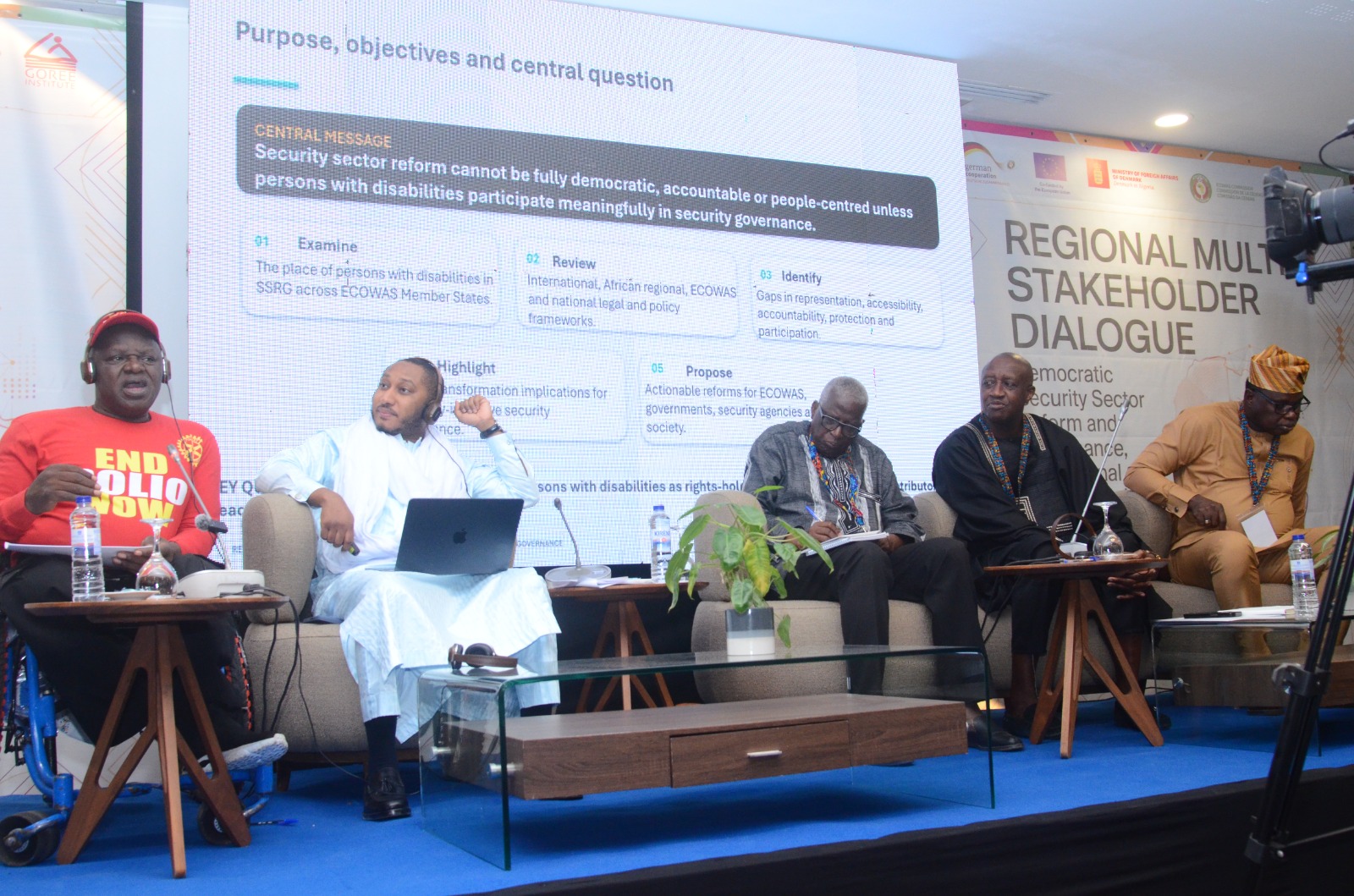
The Executive Secretary of the National Commission for Persons with Disabilities (NCPWD), Hon. Ayuba Burki Gufwan, has called for disability-inclusive security reforms across West Africa, urging ECOWAS member states to ensure that persons with disabilities (PWDs) are protected and actively involved in security governance.
Gufwan made the call while presenting a paper titled “Persons with Disabilities in the ECOWAS Security Sector: Reform and Democratic Governance of the Security Sector” at the Regional Multi-Stakeholder Dialogue on Democratic Security Sector Reform and Governance, Institutional Stability and Human Security in the Digital Age, held in Dakar, Senegal. The dialogue brought together security officials, policymakers, civil society organisations and development partners to discuss inclusive institutions, democratic accountability and human security in the digital age.
The NCPWD boss identified policy exclusion, heightened vulnerability and inadequate disability data as major barriers to the inclusion of PWDs in security governance. He noted that disability issues remain insufficiently integrated into regional peace and security policies, humanitarian responses and security sector reform programmes.
He further highlighted the risks faced by PWDs during armed conflicts, forced displacement, humanitarian emergencies and security operations, stressing that inaccessible infrastructure, communication barriers and inadequate institutional support often prevent them from accessing protection and essential services.
Gufwan emphasised that security should be viewed as a human right, a component of democratic governance and an area in which persons with disabilities must participate as active contributors. He maintained that PWDs should not be treated merely as victims of insecurity but recognised as stakeholders in policymaking, conflict analysis, community peacebuilding, security research and public accountability.
“Exclusion often results from environmental, institutional, communication and attitudinal barriers, not simply from an individual’s impairment. Reform must address both the conduct of security personnel and the systems that determine who can access protection, influence decisions and seek redress,” he stated.
He identified six major security challenges affecting PWDs across West Africa: conflict and displacement, communication barriers, heightened protection risks, limited access to justice, political exclusion and economic insecurity. These challenges include inaccessible evacuation routes and shelters, the absence of security information in accessible formats, increased exposure to violence and exploitation, inaccessible police stations and courtrooms, inadequate representation in peace negotiations and the loss of livelihoods during crises.
To address these challenges, Gufwan proposed six governance principles for disability-inclusive security sector reform: legality, civilian oversight, accountability, accessibility, human security and meaningful participation. He stressed that these principles should be incorporated into security assessments, policymaking, budgeting, implementation, monitoring and institutional reforms.
The Executive Secretary also called attention to gaps in disability representation, accessibility, accountability and protection across ECOWAS member states. He highlighted the need to review international, African, regional and national legal frameworks while addressing the implications of digital transformation for inclusive security governance.
According to him, Nigeria, through the NCPWD and President Bola Ahmed Tinubu’s Renewed Hope Agenda, is advancing disability-inclusive governance initiatives, including the National Farm Cities Project and inclusive budgeting, and is willing to share its experiences with other ECOWAS member states.
Gufwan urged the ECOWAS Commission, member states and security institutions to adopt the Washington Group Short Set of Questions on Disability for data collection, ensure the participation of organisations of persons with disabilities in security sector reform, conduct accessibility audits of security facilities and communication systems, and establish disability desks across police, military and civil defence formations.
He maintained that disability inclusion must become an integral part of security sector reform to ensure that persons with disabilities enjoy equal protection, meaningful participation and access to justice, while contributing to peace, stability and democratic governance across West Africa.
Join Inclusive News Network WhatsApp Community For Quick Access To News and Happenings Around You.