


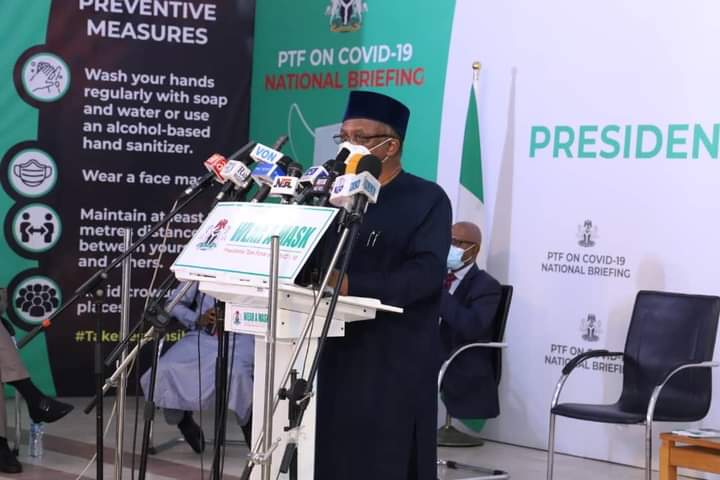
Minister for Health, Dr. Osagie Ehanire has said that the Federal Government is applying every bit of caution to prevent a spike in Covid-19 cases as schools reopen for West African Examination Council (WAEC).
Ehanire, who spoke while fielding questions from journalists during the Presidential Task Force on COVID-19 Press Briefing revealed that the strategies adopted by other countries are being observed for possible adoption where it is favourable.
He said, “As you know we are all observing all other countries; everybody is observing the other and seeing what they do and what works and doesn’t work.
And it has been observed that if actually spikes occur by doing certain activities like when you open schools or transport system or reopen classes, some countries have been forced to shut down.”
He explained that every country wants to reopen their economies and get things going but that emphasis is on saving lives.
“So, that balance between saving lives and preserving lives is what it’s about in PTF and we are trying to get both at the same time. It is a very thin line,” he said.
The Minister of Health further pointed out that the responsibility of managing spikes does not lie with Government alone but with everybody, including citizens, all the sub-national Governments, as well as the media has a role to play in helping to enlighten the public to be able understand the needs that go along with reopening the economy.
“There are responsibilities and there are activities that will mitigate the harmful effects of reopening the economy.”
Specifically, he said “We are looking at arrivals, the arrivals that come by air usually from other countries, some of them by land too, which we manage carefully; we are preparing for those arrivals if and when commercial air transport opens.
“We want to be able to do screening by taking usual port health screening and taking samples of arrivals at the airport so that we can test immediately those who have arrived carrying the virus or not.”
Explaining further, the Minister said “The other one is what I just announced in my speech earlier, that we are trying to expand sample collections to rural areas because you might not find a spike if it’s in a rural area that is not being very well monitored and there is reason to believe now that if we focus too much on cities and urban areas we might miss what is going on in small towns and less urban areas. So we want also to start looking at those areas, that’s why I mentioned oxygen kiosks in Local Government Areas and sample collections, all those are parts of strategy to start getting ready for the spikes we might have and these spikes might not necessary be in cities, it might be outside.”
“Then the important one which I started with, which is the risk communication where all of you sitting here today are all involved in; educating the public, community engagement; we were talking today about trickling down the response to community leaders, gate keepers of the communities, religious leaders, hospital leaders and traditional leaders to help to domesticate the idea of non-pharmaceutical interventions and measures for the people to be more compliant.
“So, we believe that if we are diligent in keeping to these prescriptions, the impact of gradually reopening the economy will be well mitigated and we may be able to get to reopening the economy and not seeing spike or we may just see a minimal spike. But let me say again that it is the responsibility for everybody, for all of us here in this room today”, the Minister added.
Asked of the possible re-infection after being treated or cured of COVID-19, Ehanire said he would rather leave the conversation for the World Health Organization (WHO).
“If people can be re-infected twice, or if people can be re-infected again, it is too early to say because we have had COVID-19 for only about five or six months for us to really know.
“From what we’ve read, I’ve read that only about 60 percent of people who got COVID-19 infection actually develop enough antibodies which mean that in fact, not everybody who had COVID-19 actually got enough antibodies and that the antibodies actually began to wane in about three months or so. Only about 17 percent still has antibodies,” he said.
He however conceded that the WHO Country Rep will fill up on that because these information constantly changes as we learn more and more.
He further explained that building antibodies is what actually protects you from re-infection and “If it is said that 60 percent build sufficient antibodies, well, nothing was said about the remaining 40 percent.
So it’s something that I believe science will eventually show or those who have seen what the latest information is, will also guide us and if the antibody matter.
However, if the antibodies begin to reduce after some months, then that is not very good news. But like I said, the information is constantly changing, as more and more research results begin to emerge.”