


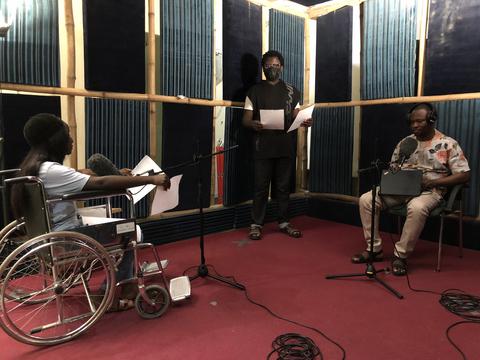
A popular radio drama which reflects the lives of ordinary Nigerians is back on air across sub-Saharan Africa with a new focus – to transform attitudes around people with disabilities, with storylines, actors and writers that reflect their experiences.
Story Story – Voices from the Market, produced by the BBC’s international charity, BBC Media Action, has returned to BBC Africa after a three-year hiatus. When it last aired, Story Story – set in a traditional West African market – was broadcast across 111 local partner stations and on BBC Africa, reaching an estimated 20 million people.
Now, BBC Africa has begun airing episodes which explore and challenge negative stereotypes and myths around disability and neurodiversity, including those around relationships and sexuality, and encourage more inclusive attitudes towards access to education and employment for people with disabilities. The series is part of the Inclusive Futures development consortium led by Sightsavers.
One of the stars of the programme is Emmanuel ‘E. Daniels’ Busabaye, a Nigerian musician and producer with a visual impairment, who plays a shop assistant learning to change his perceptions of people with disabilities, and challenging others across the continent to do the same.
E. Daniels said: “What impresses me about Story Story is the scripting. Being able to put together this thing, in very plain terms, so that every kind of person listening to it will understand and get the message clear.
“Giving me the character of Bulous, and then noticing this character was not a character with a disability was exciting for me….It’s not because you have a disability that you should come and act this.”
There are an estimated one billion people living with disability in the world; 80% of them live in low and middle income countries. In many parts of the world, people living with disability report frequent harassment and discrimination, and struggle to access education, health care and employment.
Inclusive Futures is a consortium of 16 international organisations, led by Sightsavers and including BBC Media Action, funded by UK Aid. It works with the public and private sectors, people living with disability and organisations that represent them, to work toward equal opportunity and full inclusion in society, particularly in education, health and employment.
Initiatives such as Story Story aim to raise awareness and understanding of the issues people with disabilities face, in a way audiences can relate to.
Rasak Adekoya, Inclusive Futures lead for Sightsavers in Nigeria, said: “I think the media has a lot of role to play in dispelling the myths around disability inclusion, in terms of the language, in changing to use the right words and language.”
Story Story is produced by BBC Media Action with a new, fully disability-inclusive writing team, who underwent disability-inclusion training before creating new characters and storylines representing a wide range of abilities.
Story Story writer Sonia Nwosu said: “The first thing we did, apart from knowing the characters and their world, you have to know the disability issues that there are, and really what are the gaps in society that need to be filled. It wasn’t until then that we were able to understand that it isn’t people with disabilities adapting to the community, but the society that would become more inclusive.
“We need to adjust our thinking, we need to adjust how we are, to be more inclusive and more accepting.”
Recent research, based on a household survey of more than 5,600 respondents conducted in the project’s five focal states in July and August 2021, shows that over a quarter (28%) of listeners say they have done something differently as a result, including treating people with disabilities more kindly (81%), being more friendly with people with disabilities (69%) and no longer discriminating against people with disabilities (60%). Almost half (47%) of listeners have discussed what they learned with family or friends.
Research has shown that people who are most engaged with the drama have more positive perceptions of disability and people with disabilities, compared to those who do not listen. This is true even when controlling for factors such as higher education levels and previous contact with people with disabilities.
Story Story resumed airing on BBC Africa in late August and is also available on BBC Sounds.