


Paul Okah
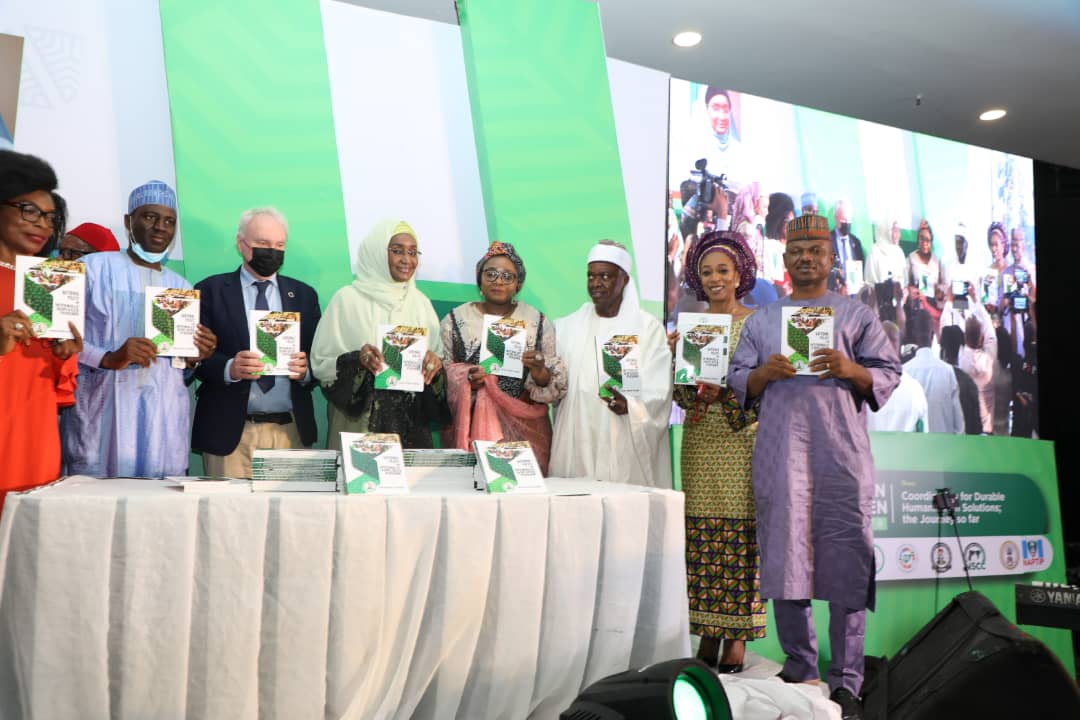
Following its determination to provide timely information to the public on its activities, the Ministry of Humanitarian Affairs, Disaster Management and Social Development, in collaboration with all agencies under the ministry, has launched the Humanitarian Open House and the Internally Displaced Persons (IDP) Policy.
Speaking during the launch Tuesday in Abuja, the Minister of Humanitarian Affairs, Disaster Management and Social Development, Sadiya Umar Farouq, who reeled out the achievements and challenges of the ministry since its establishment in 2019, said that “the event is a strategic communication initiative that brings together the partners, stakeholders, media private sector, development partners, CSOs/NGOs in an event where a scorecard of the Ministry’s programmes, projects and interventions is presented.”
She said: “The need to harmonize, synergize, institutionalize as well as provide coordination of all government’s humanitarian and social interventions led to the creation of the Federal Ministry of Humanitarian Affairs Disaster Management and Social Development in 2019.
“The activities of the Ministry impacts directly on the well-being of poor and vulnerable Nigerians and contributes to the socio-economic development of the country. Understandably, this has placed the Ministry in a close friendship with the media sector in Nigeria, humanitarian actors, Civil Society Organizations (CSO’s), collaborating Ministries Departments and Agencies. (MDAs) and the general public.
“In order for the Ministry to effectively provide the much needed and desired coordination and leadership, it must have a means of effectively and consistently communicating its progress, challenges and engaging partners with and engaging partners, stakeholders and the public.
“It is against this background that the Humanitarian Open House is being hosted with the theme ‘Coordinating for Durable Humanitarian Solutions; the Journey so far.’ The Theme has been carefully chosen to allow the Ministry speak on its coordinating efforts, activities and achievements as well as milestones being attained, results being delivered and more importantly the impact the Ministry and indeed government is making in the lives of Nigerians.
“Since inception, we have achieved a lot in the area of the provision and coordination of humanitarian interventions in keeping with our mandate. We have also been able to provide coordination through cooperation and partnerships with relevant government MDA’s, development partners, UN Agencies and other partners. This is all in a bid to ensure sustained and expanded social protection programmes, prompt emergency response and appropriate humanitarian interventions.”
She added: “The need to keep stakeholders and partners including the media abreast with the Ministry’s programmes and activities is imperative to allow correct, consistent and sustained information dissemination of the mandate, vision, policy direction, activities, interventions and its huge impact to all Nigerians and others.
“Today is a day set aside for the Ministry to engage with the media, partners and stakeholders and give them the opportunity to ask questions, get clarity and offer suggestions.
“The Open House will encourage a nexus of interchange of ideas, enable the media practitioners report from an informed position as well as give stakeholders and partners first-hand information they can share across their various platforms.
“Through this programme, we hope to provide a more engaging platform for the Ministry to lead the way through connectivity, enable more synergy and cooperation between stakeholders to support and empower more people, create more possibilities, provide access to more solutions, make things happen faster and support the growing ranks of people of concern to access more interventions.
“As an integral part of this Open House, the Humanitarian Hub has been created as a veritable platform for the Ministry, its Agencies, partners and stakeholders to engage and connect with visitors, media and other partners and stakeholders.
“Beyond the robust information sharing the Humanitarian Hub will offer, it is expected to provide an opportunity for networking and sharing global best practices that will increase partnerships and collaborations and result in more impact and solutions for humanitarian challenges and social protection in Nigeria.
“As part of today’s activities, I am pleased to present the Ministry’s Information Brochure and the National Social Investment Programme (NSIP) Information brochure. The information brochure is a one- stop- shop information book containing all the basic information on the Ministry, its Departments, programmes and Agencies. Similarly, a pictorial compedium chronicling the activities , programmes and achievements of the Ministry is presented.”
Furthermore, she said: “Today, I am equally launching to the world the National Policy on IDP, which was approved by the Federal Executive Council (FEC) in September 2021. As you are aware, the process of developing and adoption of the policy commenced in 2001, within this period the initial draft of the policy have been reviewed severally to reflect new realities and emerging trends in humanitarian space in Nigeria.
“This policy intends to provide a framework for national responsibility towards prevention and protection of citizens and, in some cases, non-citizens, from incidences of arbitrary and other forms of internal displacement, meet their assistance and protection needs during displacement, and ensure their rehabilitation, return, reintegration and relocation after displacement. The policy spells out principles guiding humanitarian assistance and implementation of durable solutions in situations of internal displacement in Nigeria and has adopted the human rights-based approach and its principles.
“It integrated the provisions of existing international conventions, treaties and protocols on internal displacement, guided by the dictates of international humanitarian and human rights laws. This policy, therefore, draws extensively on the guidance of international and national frameworks on the prevention of internal displacement, as well as those on protection and assistance of internally displaced persons. The Kampala Convention, the UN Guiding Principles on internal displacement and the Sphere Minimum Standards for Humanitarian Assistance have significantly defined the direction of this policy.
“This policy envisions an equitable and stable Nigerian society that is proactive and responsive to situations that could lead to internal displacement, where the right to life of dignity is guaranteed for all internally displaced persons and where adequate measures and durable solutions exist to prevent and mitigate the impact of internal displacement on vulnerable populations.
“To ensure efficient and effective implementation of the policy, I charge the National Coordination Technical Working Group and other relevant stakeholders to commence elaboration of implementation plan with clear roles and responsibilities of all actors. The plan should incorporate a monitoring and evaluation strategy which will ensure compliance with policy framework and scope as well as determining the extent of achievement of policy goals and objectives.
“Further to this, we have commenced the standalone process of domesticating African Union Kampala convention. The relevant stakeholders is hereby chardged to come up with the draft bill for onward presentation to the FEC and the transmitted to the National Assembly for necessary legislative action.
“The last two and a half years has been a potpourri of programmes, activities, interventions, partnerships, and sometimes challenges and unexpected humanitarian crisis.
“Together we have remained resolute and undaunted in the face of the humanitarian challenges. I am confident that we will get through them as we continue to have all hands on deck and ensure relevant MDAs and other stakeholders and partners come together to tackle the different issues and provide timely and lasting solutions.
“We have formally initiated inter-ministerial coordination across several of the focal points where our Ministry mandate intersect with other MDAs, including the private sector and with International Development Partners, NGOs and INGOs.
“Our goal is to meet the needs of the people who need a helping hand from Government to restore hope, provide support and succor as well as an enabling environment for recovery, rehabilitation and inclusion while ensuring their human dignity is upheld at all times.”