


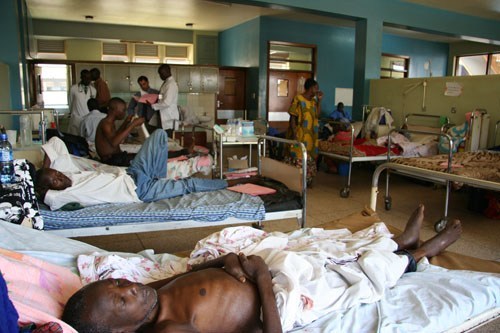
Doctors and other health personnel at the 16 General Hospitals in the Federal Capital Territory (FCT) are working themselves out as they take a minimum of 1,000 deliveries monthly through Caesarean Section (CS).
Some of the families said that they accepted the CS option during delivery to save either the life of the mother or baby, and at times both.
Even though 50 per cent of child delivery in the FCT is still being done in private clinics or traditional homes, LEADERSHIP Weekend gathered that an average of 2,400 deliveries are recorded monthly in the 16 general hospitals in the nation’s capital.
Of this figure, the minimum number of women who delivered their babies through CS is over 1000, the authorities said.
In Nyanya, a highly -populated settlement in the Abuja Municipal Area Council (AMAC), the General Hospital carries out between 65 and 75 caesarean sections monthly from 150 births.
Also, in Bwari General Hospital, an average of 60 caesarean sections is done monthly, Kubwa 70, Kuje 65, Asokoro 75, Karshi 50, Gwarimpa 60, Wuse 60, Abaji 50, Kwali 55, Maitama 75, and Robochi 60.
But some medical experts say the number is higher than the figures gathered by LEADERSHIP Weekend.
“It’s a very modest figure. The actual number is more than that,” the chairman, Nigerian Medical Association (NMA) in the FCT, Dr. Ekpe Philips Uche, said.
Uche, who is a consultant gynecologist with specialty in reproductive health and in-vitro fertilisation (IVF), said that 50 per cent of deliveries in Abuja take place in private hospitals.
On why the CS rate is on the increase, Uche, who doubles as the chief medical director, Nyanya General Hospital, said that they would rather go for CS than to lose the mother during childbirth.
He said: “It’s part of the management of the cases as they present. We rather have a caesarean section than have a woman die. We should not look at the natural way and say, oh, it must be normal delivery.”
The NMA chairman, who said doctors don’t just go on doing caesarean section for a woman, added that there must be cogent reasons for it.
“If the placenta is lying low, you won’t say the woman must deliver normally. If the baby is transverse you won’t say the woman must deliver normally. If the woman is in labour and the foetus heart rate is showing distress, you won’t say she must deliver normally. So, there are so many reasons why caesarean section takes place,” Ushe said.
“So many of them, especially the unbooked ones, have actually been messed up probably in primary healthcare centres or in their houses; they have held onto them, so if you bring them at that point, we have no option than to do a caesarean section,” Uche said.
The medical doctor who lamented poor funding of Nigerian hospitals added that government at all levels always say delivery in public hospitals is free but won’t upset the bills.
“Sometimes, we even feed these women thinking one day, their family members, church people or a good Samaritan will come and pay their bills,” Uche said of the conditions of the women they often handle at childbirth.
“The government said that delivery is free but they don’t pay. These hospitals are constrained to use the internally generated revenue to pay for those services. Remember that the hospitals have to buy diesel and other things to run such services,” he lamented.
On how to save women from dying during childbirth, Uche said that it is not about building the primary healthcare centres and put people who do not have all it takes to handle the patients.
The CMD said: “If you build a basic healthcare centre and put a community health extension worker and a nurse to man it, you expect that nurse to give the injection. If there is an adverse reaction what happens?
“If you want to give a drip, who calculate the amount you give before you refer the patient? These are very important issues and our primary healthcare is not maximally utilised. They are not offering 20 per cent of what they are supposed to do. The problem we have is majorly manpower. And the reason for the lack of manpower is that government is not engaging the doctors. Let it be that the doctors are the ones turning the offers down. Make the primary healthcare centres conducive. As you build the centres, provide accommodation for the workers; have a source of electricity. Make life a little bit better for them,” he said.
Uche added that Nigeria suffers from poor medical services because 50 per cent of the doctors trained in the country are unemployed.
“Where you should have one doctor to 600 patients, in Nigeria, you have one doctor to 6,000 patients,” Uche said, adding that it was below the standard of the World Health Organisation (WHO).
“In UK, what they are doing is to have one doctor to below 300 patients. And what they are doing to achieve that is that they open up their borders to allow our professional doctors to come into their country.
“It takes roughly about $5,000 to train a doctor in the US. After that, when they start working, they pay back the grant. However, in Nigeria it does not take that much because education is subsidised.
“The governments at the state and national levels have invested in the education of doctors who are not employed, but they are being taken away by other countries. Spending that kind of amount that have been spent in the training the doctors who now move over to the UK, US, Canada Australia, Dubai, Saudi Arabia, is not good.
“At the end of the day, we lose our best hands that are supposed to take care our patients. It’s a relative thing. The doctors are not enough. Not only the doctors, the health personnel are not enough. The pharmacists, nurses and others are not just enough in this country. So, we should keep the ones we have but that is not happening. We have so many doctors roaming the streets of Nigeria without jobs,” Uche said.
According to him, “it’s difficult to have that statistics of how many doctors are unemployed in Nigeria, but I can tell you that 40 per cent of trained doctors currently in Nigeria are not employed.
“So many doctors who finished their youth service still spend one to three years at home before getting a job. Many of them are taking up jobs in private hospitals that are not even paying them well because of the economy.
“So, we don’t have enough doctors in Nigeria. We don’t have enough health personnel in Nigeria. Even the ones we have are not being utilised because we don’t engage them. Now, because of insecurity and poor infrastructure, you have a situation where doctors are now moving to towns. They move to Abuja, Lagos and other capital cities of their states. They don’t stay in the villages. Why? The same reasons why you are here,” he said. (LEADERSHIP)