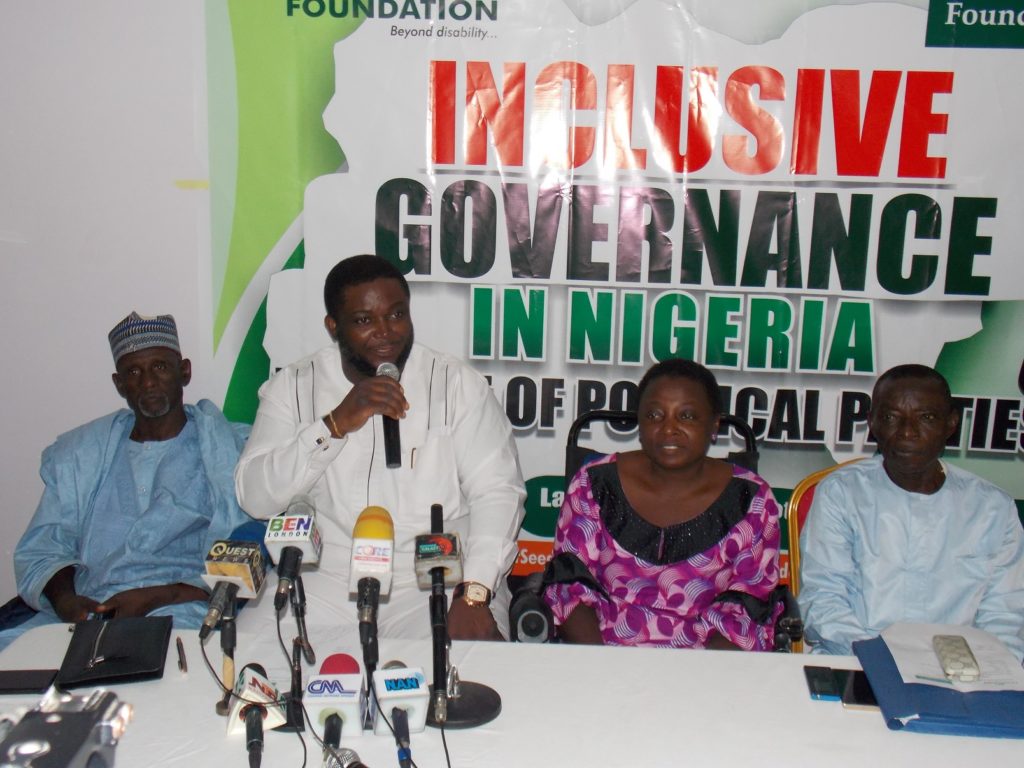
House of Representatives considers a bill to reserve 20 per cent job slots for Nigerians with disabilities.
Leke Baiyewu, Abuja
The House of Representatives is considering a bill to make the Federal Government’s ministries, departments and agencies to reserve 20 per cent of job slots for physically-challenged Nigerians.
The law is being proposed in a bill sponsored by the Speaker, Femi Gbajabiamila.
The Physically Challenged (Empowerment) Bill 2017, which was first presented in the Eighth National Assembly, was reintroduced and passed the first reading in July 2019. (Punch)
Person with disability lauds Gov. Obiano for state of the art healthcare facilities.
Persons with disabilities in Anambra state have lauded Gov. Willie Obiano for providing good healthcare facilities in the state in an attempt to reduce incidences leading to disability conditions.
ChuksEzewuzie, the Anambra state senior special adviser to the governor on disability matters, said that the lives of most persons with disabilities would have been better managed if they had access to good medical care in a good healthcare facilities when they discover or are diagnosed with disease or situation that resulted in their deformity or disabling condition.
Chuks added that he would not be blind today if he received good medical care when measles attacked his eyes which caused him to lose his sights.
“90% of persons with visual impairment in Anambra State share this same story. The other 10% may have resulted from mismanaged diabetes melytus infection, cataract and glaucoma surgeries or other accidental events.” He disclosed.
“This is why we celebrate the reconstruction and upgrade of Immaculate Heart Multi-specialty hospital, Aguleri as a landmark investment in disability prevention.”
He futher noted that the unaffordability of existing healthcare centres is a factor in losing the fight against self-medication, improper diagnosis and substandard treatment which create deformity responsible for temporary or permanent disabilities.
Describing Gov. Obiano as the “consoler”, he says “Gov. Obiano has made two grand breaking achievements in disability prevention. The first was the introduction of Anambra State American Patterned health Insurance Scheme. Unaffordability of existing medical care is a major factor in the losing war against self-medication, improper diagnosis and substandard treatment which create deformity responsible for temporary or permanent disabilities.”
“The Anambra State Health Insurance Scheme, without excluding pre-existing health condition, is more affordable than any such programs in the developed world. Just one thousand naira a month (twelve thousand naira a year) buys the coverage for all known conditions. Can there be any better gift from Ndi Anambra in diaspora to their loved ones in Anambra State?”
The SSA lauded Governor Obiano’s investment in Healthcare as he said that the investment is expected to minimize disabilities and reduce the statistics in Anambra State.
“It is estimated that 27 million Nigerians are living with disabilities, that is about 14% of Nigerian population as of 2019. Governor Willie Obiano ‘s investment in Health care is expected to minimize disabilities and reduce the statistics in Anambra State.” He concluded.
INTRODUCING DO-ESTDOT INTERNATIONAL SCHOOLS, THE MOST INCLUSIVE SCHOOL IN NIGERIA.
SPONSORED POST:
DO-ESTDOT International School was founded in 1998, it is one of the most INCLUSIVE schools in Nigeria and fundamental in ensuring her mission that individuals with special needs ought to be identified, celebrated and encouraged to embrace their dreams because only a self-aware citizen can move a nation forward and it is very normal to be different. Our diversity sees to it that even the hearing children are able to use sign language because of the diversity in today’s world.
Consistently operating at an ever growing peak, our students contribute to a thriving atmosphere that seeks to breed thinkers, doers and knowledgeable students. We are ensuring our unique education is accessible to students from a broad range of backgrounds.
Our staffs are professionally recruited and our management principle ensure a productive relationship between parents, teachers and students.

Our beautiful and conducive environment boasts of
– Spacious and well ventilated rooms
– Baby friendly toys
– Very conducive and international standard environment
– Professionally trained care givers
– Audio-visual facilities.
– Child friendly curriculums for kids with special need.

At Do-Estdot International School we cater for the education of;
– Special Needs Wards
a. Occupational Therapy.
b. Speech Therapy.
c. Physiotherapy Services.
– Hearing Impaired / Deaf Wards
a. Sign Language
b. Speech Therapy
– Regular Learners
a. Pre- School
b. Elementary Education
c. Secondary School.
A visit to the school is a trial that will convince you. For Enquiries please contact us at;
4/14/16, Ifelodun Street.
Council Bus-stop, Idimu, Lagos
or by email info@doestdot.sch.ng.
visit our website at www.doestdot.sch.ng
or call/sms / whatsapp 08164824613, 08161309449, 08130070242
CBM Celebrates World Humanitarian Day, Recognize Two Humanitarian women focus on “Inclusion”
The Christian Blind Mission has honoured two women humanitarians that focus more on Inclusion of persons with disabilities in their project settings as it mark international humanitarian day. They are Deborah Tigere from Zimbabwe and Tahmida Akter from Bangladesh. CBM shared the information on its website and was obtained by INN.
Read the full story below;
“Every 19 August, World Humanitarian Day is set aside to honor humanitarian efforts made around the globe and to assert the need for supporting people in crisis.
This year, World Humanitarian Day 2019 is celebrating women humanitarians and their contributions toward making the world a better place. At CBM, we would like to highlight the work of two women working in crisis situations: Tahmida from Bangladesh and Deborah from Zimbabwe.

Tahmida Akter discusses feedback and complaint mechanisms with persons with disabilities from the Rohingya population in the Cox’s Bazaar refugee camp. July 2019.
Tahmida Akter is in Inclusion Coordinator for CBM partner Centre for Disability in Development (CDD) in Cox’s Bazaar, Bangladesh. There she works to support the inclusion of older persons and persons with disability in response to the Rohingya crisis.
Tahmida coordinates disability mainstreaming projects and provides technical support within the refugee camp, as well as managing a team of inclusion officers. She also works with humanitarian agencies so they can access the support for disability mainstreaming her team provides.
One of the biggest challenges Tahmida faces is the lack of training or knowledge among humanitarian actors on how to include people with disabilities in the work they carry out.
Yet, Tahmida is resolute despite the challenges she faces. She enjoys advocating and promoting disability inclusion among humanitarian agencies and finding contextual solutions. She says:
“I hope and believe that government and humanitarian agencies will be more aware and continue to show more willingness to increase disability mainstreaming. I also hope that people with disabilities will get more opportunities to strengthen their representation in disability mainstreaming and inclusion, and will therefore be more involved in global development.”

Farayi Makwanya (right), Deborah Tigere (CBM Zimbabwe Country Director), and Michael Mavhima in Harare during a team building activity in February 2019.
Deborah Tigere is CBM Country Director in Zimbabwe. In the Manicaland and Masvingo Provinces, Deborah has been working hard with CBM partners to implement an inclusive response to the devasting Cyclone Idai.
Cyclone Idai’s mudslides, misty weather and continuous rainfall made rescue operations and access to affected areas highly difficult. Most challenging was obtaining access to information in affected populations to determine the type of assistance needed.
Deborah was instrumental in CBM’s inclusive humanitarian efforts to provide food and assistive devices after the cyclone, and to provide support for other humanitarian actors to mainstream disability in their response.
Deborah’s work is important to ensuring that people with disability are more included in development and humanitarian response in the future. As she says:
“In light of the disaster, my thoughts as a development worker are centred around inclusive disaster preparedness plans, e.g. establishment of accessible early warning systems and capacity building of communities to cope. Effective prepared plans will save more lives and minimise the impact.”
So, Happy Humanitarian Day, Tahmida and Deborah! We are thankful for the work you do, and for all the humanitarian heroes around the world today and every day!”
A family of four visually impaired persons have defied all odds to enter into agriculture at Assin Lartteh in the Assin North District of the Central Region to fulfil the “disability is not inability” mantra.
It is the decision of the family that they can’t be begging on the streets for money and food when their children have the strength to work on the farm.
Information gathered by Adom News suggests the four-member family of Mr Kwaku Lartey, 70 who is the father; Akua Yirenkyiwaa, 65-year-old mother; and their two sons – Kwaku Ofori and Kwadwo Antwi, 32 and 25 respectively have battled with blindness for the past 15 years.
Mr Lartey, head of the family, claimed his family suffered the blindness after he sacked the caretaker of his cocoa farm over mismanagement.
“We handed over the cocoa farm to a caretaker to work on for us to share whichever profits may have accrued but as the years went by, we incurred losses, so I had to sack him and this led to serious problems between us,” he narrated.
Upon sacking him [the caretaker], he threatened to render the entire family blind through magical powers when he returns to his hometown and a few weeks later, all of us got totally blind till date,” Mr Lartey explained.
Akua Yirenkyi, wife of Mr Lartey said all attempts to regain their sights have proved futile because the caretaker who is believed to be the one person who can revoke the curse had died.
Meanwhile, Mr Lartey is appealing to philanthropist to support them with agrochemicals and other agricultural inputs to improve the yield of their farming activities. (Adomonline)
A Brief Epistle of Dr. (Mrs) Agnes Ojile: A Woman that has the Deaf at heart.
By Kadir Abdulfatai
Dr. (Mrs) Agnes Ojile is a lecturer in the department of education psychology, faulty of education, University of Jos.
She is more than a mother. She is a woman with a sense of humour and kind heart. A very loving woman whose inspiration and mentorship everyone will need most. She is like a rose that beautifies the ugliness in someone’s face. A woman who always puts smile on everyone’s face. She is like MTN that everywhere anyone is, will find her because she is loved by everyone everywhere.
I came cross this woman quietly by a colleague during my undergraduate studies at the prestigious University of Jos. The story told about her was very touching. In fact, upon hearing about her affectionate for the Deaf students, she defies deafness in the mind of the Deaf believing that deafness is not an insurmountable barrier to greatness.
However, what drives her to love Deaf individuals more is the ability and potential she has seen in a lot of persons with disability, who have achieved various greatest endeavours. To prove it, the blessed memory of her beloved husband ( Late Prof Ojile), who became the first and only Deaf professor in the department of Special Education and Rehabilitation Sciences, University of Jos.
Consequently, it has taken me for the past three years to come to terms with the fact that I cannot forget someone as her, who is so dear to many deaf people. The invitation of her recent reception ceremony for bagging a PhD in which she invited Deaf students to showcase their talents, gives me more inspiration to write a good epistle about her.
It is indeed most gratifying to see her efforts in promoting the advance and rights of the Deaf and helping humanity being recognised and awarded. I pray that our Creator would recognise you the more according you the aware of PERFECT HEALTH.
Nevertheless, as a education psychologist, she has always been up as a guiding light to many of us coming behind her. She has again given those of us who were privileged to pass through her course; her teaching has also imparted knowledge to us. Some disabled related topics are in her course( education psychology), if she lectures it she will treat it with hearing students most especially NEGATIVE ATTITUDES TOWARDS PERSONS WITH DISABILITIES. She has always taken this area serious because of her love for persons with disabilities. As a education psychologist, her understanding and care for the Deaf is second to none.
She has been conferred with a Philosophy of Doctorate.
Ma, my sincere congratulation to you for successfully completing your education most importantly along with degree of PhD. Indeed, you should consider this as one of your greatest achievements in life. By the grace of God, you will make it to the rank of a professor. I wish and pray that you will find real happiness and satisfaction, as well you start making a new life. God bless you more.
About the writer,
Kadir Abdulfatai is a special educator and a graduate of University of Jos. He is currently serving his mandatory NYSC service in Kano state.
Hon Hezekiah Dimka presents sallah gifts to people with Disabilities in his Constituency (photo).
This Sallah in Dengi town the distinguished Sen. Hezekiah A. Dimka donated bags of rice and rams to the Kanam Disabled Community in honor of the sallah celebration.
The presentation of the gifts were done on behalf of the Senator by Hon. Kyennan Mizim of the Plateau state Disability commission.
Hon Dimka stated that the disabled community would continue to form part of his priority as far as the empowerment of the Plateau central is concern.
The event had in attention the Jni chairman of Kanam LGA, Alh. Salisu Albala, the Darman Kanam as special guest.
Similarly, donations was made in the five LGAs of the Plateau central respectively. (PLATEAU NEWS ONLINE)
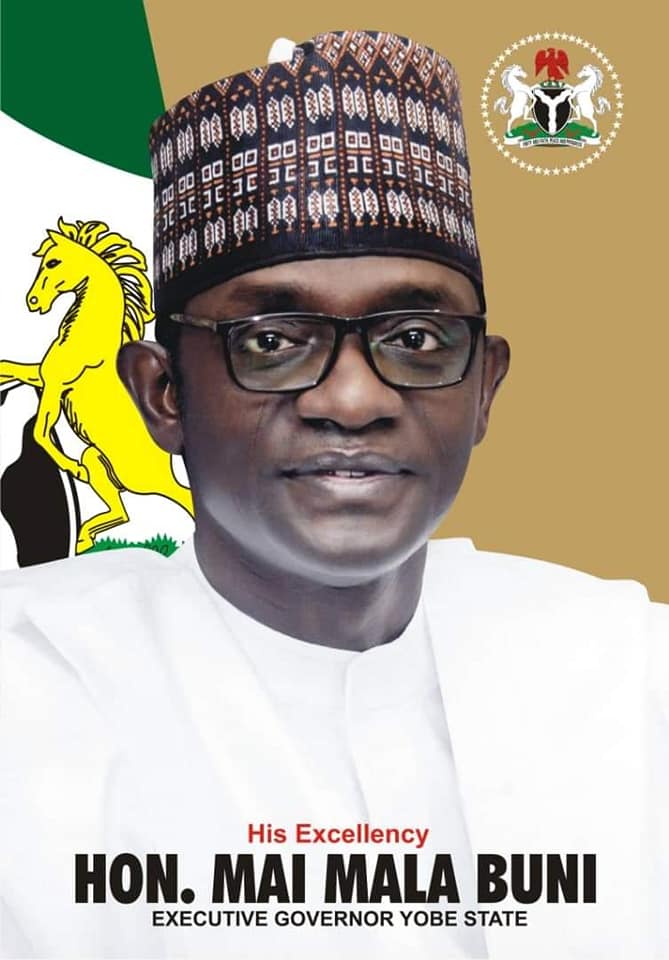
Gov. Buni lunches strategic empowerment for people with disability, to send 20 undergraduates on oversea scholarship.
By Joel duku blog
In complaince with inclusivity in governance, Yobe State Governor, Mai Mala Buni has ordered the inclusion of 20 students of physically challenged status to be included in the on going scholarship scheme to indigent Yobe State Students.
The orders of the governor is contained in a statement signed by the Northeast Zonal Special Leader of All Progressive Congress(APC) Comrade Mohammed Abba Isa who is also a member of the Yobe State Technical Committee on the revitalization of Education in the State..
The statement which described Gov. Mai Mala Buni as the ‘Mater of Inclusion the scholarship will only cater for the physically challenged students who passed their WAEC with five credits including English and Mathematics who will be heading to a Turkish university for their studies after the selection process.
The Statement however announced that students with visually impaired and the one with hearing impairment will not be considered for this time but called on them to be patient as they would be considered in the next batch.
Comrade Isa also expressed gratitude on behalf of his people to the governor for giving them the opportunity, while calling on other states to emulate from Gov. Mai Mala Buni.
The Statement reads in full:
“This is to inform the members of National Association of Persons with Physical Disability (NAPWPD) Yobe state chapter, that His Excellency the most disability friendly Governor, Governor Mai Mala Buni the executive governor of Yobe State has approved the selection of twenty (20) Persons with physical disability across all local government of the state who passed with 5 credit including Maths and English in their O’level for immediate consideration for traveling to Turkey for their university studies under Yobe State Undergraduate Scholarship Program.
“While we commend his Excellency’s gesture for this wonderful opportunity we also want to use this opportunity to inform other disability clusters visually impaired, Hearing impaired and others that, the selection would be done in batches as such subsequently other clusters would be considered.
“Conclusively, while this remains first of its kind in the State and the entire country we encourage other state to learn from the good gesture of master of inclusion himself.
“We remain grateful and May Allah SWA guide you in achieving your good vision to the people of Yobe State Amen”.
Analyst observed that the governor’s initiative to give such an opportunity to people with disability is one strategic investment that would have a long term effect on the empowerment of people with special needs in the society.
Persons with disabilities laud Gov. Mai Mala Buni as he shares sallah packages to Pwds in Yobe State.
Persons with disabilities in Yobe State have lauded His Excellency, Gov. Mai Mala Buni, for his kind gestures as he shares sallah packages among special people to mark the Eid Mubarak day on Wednesday, 7th August, 2019 in the state.
INN can report from source that the Yobe state Governor, Mai Mala Buni distributed 5000 food items to elderly people, windows and the indigenes within the communities across the state which also include people with disabilities.
Governor Mai Mala Buni, who was represented by the Executive Secretary of State Emergency Management Agency, Goje Mohammed, while flagging off the distribution in Buni Yadi, said the gesture was to meet the food need of aged persons who could not farm or sustain their means of livelihood and the Internally Displaced Persons (IDPs) that first returned to their liberated ancestral homes in Buni Yadi, Buni Gari and Kukuwa towns.
The governor added that each of these beneficiaries are going home with 50kg of rice, 20kg of sorghum and 5 litres of cooking oil.
“This will at least put food on their tables and bring succour to their lives,” he explained.
Thanking the governor, on behalf of Pwds, for his kind gesture was Com Mohammed Abba Isa the APC Zonal Disabled Leader Northeast Nigeria.
He described the governor as the master of inclusion, the architect of modern Yobe state and the most disability friendly governor.
In his words, “we wish to register our profound gratitude and unreserved appreciation to the MASTER OF INCLUSION, the architect of modern Yobe state, the most disability friendly Governor His Excellency Mai Mala Buni the executive Governor of Yobe state for not only identifying with us but recognising us as key stakeholders in the project of building new Yobe state….” “Sir, your singular act of including us as beneficiaries and worthy recipient of Sallah gift (Food items) Has indeed proven your desire for good living conditions for persons with disabilities in the state”, the elated Abba Isa said.
“We say thank you and we would continue to pray for your successful Hajj, and Allah’s grace upon you to come back and continue your good work. We remain grateful”, he concluded.
NGO wants govt. to produce documents, educational materials in braille
By Philip Daniel Yatai
The Knowledge for the Blind Initiative, an NGO, on Wednesday urged government at all levels to reproduce public documents and educational materials in braille to meet the needs of the blind.
Its Executive Director, Mr. Andrew Gani-Ikilama, told the Nigeria News Agency in Kaduna, that the step would strengthen government’s quest for inclusive education and governance.
Gani-Ikilama also said that the measure would also increase access to information and career choices among the blind and people with low vision in the country.
He noted that, although government was making efforts to ensure no one was left behind in governance, education and political space, the blind were still being discriminated in terms of access to information, academic materials and career choices.
“For example, the blind cannot access government public documents because they were not reproduced in braille.
“This make access to information and participation in governance very difficult for the blind.
“They were also forced to study certain courses in tertiary institutions because the study materials were not in braille, thereby denying them the opportunity to pursue their educational dream in life.
“It is important to note that access to information and education is a right and not a privilege.
“Therefore, government at all levels must consider the needs of the blind when producing public documents and educational materials, including programmes of event during public gatherings,” he said.
He disclosed that the NGO has set up a braille production centre in Kaduna, the first in the country, with the capacity to produce maps, diagrames and other symbols for the blind.
Gani-Ikilama explained that the equipment was donated by Sir Ahmadu Bello Memorial Foundation to improve access to information and education by the blind and those with low vision in the country.
“The centre will support the production of newspapers, government documents and educational books in braille for the blind to pursue their educational career in any university or polytechnic in the country.
“There was a lady in this country that wanted to study physiotherapy but ended up studying law, because the study materials were not in braille.
“My father is blind, and he studied physiotherapy in England because the study materials were reproduced in braille.
“He worked as a physiotherapist at LagosUniversity Teaching Hospital and Ahmadu Bello University Teaching Hospital before he retired. This is now very possible for the blind in this country,” he added.
He commended the DFID-funded Partnership to Engage, Reform and Learn, Kaduna State Office, for supporting the Disability Community to push for the passage of Disability Bill in Kaduna state.
He, however, pointed out that the draft bill was not produced in braille for the blind community to go through and make necessary observations and input.
“We are here to fill-in such gaps and to ensure that no blind person in this country is denied the right to information and the right to make certain choices due to lack of vision,” the director said.
Deaf pupils in England struggle at every stage of school, report finds
By Sally Weale Education correspondent
Campaigners say children face ‘lifetime of being left behind’ amid cuts to support services
Deaf pupils in England are struggling “at every stage of their education”, with fewer than half leaving school with two A-levels, compared with almost two-thirds of their hearing peers, according to new analysis.
The National Deaf Children’s Society (NDCS) analysed government data and found that 44% of deaf pupils achieve two A-levels or equivalent, compared with 63% of hearing pupils.
Fewer than three-quarters of them (73%) will gain five GCSEs or equivalent by the age of 19, compared with 88% of hearing pupils. If English and maths are included, that figure goes down to just over half (52%) of deaf pupils and three-quarters (76%) of their hearing classmates.
The analysis was published before A-level results day on Thursday, when deaf pupils are expected to significantly underachieve again, with similar disappointing results expected for GCSE students the following week.
“Deaf children arrive at school with amazing potential only to begin a lifetime of being left behind,” said Susan Daniels, the chief executive of NDCS. “While some of them are achieving incredible results and going on to their dream jobs, these results show that many more are being completely failed by the system on which they rely.”
The attainment gap between deaf children and hearing children is evident before pupils start secondary school at the age of 11. Fewer than half (43%) reach the expected standard for reading, writing and maths at key stage 2 (KS2) at the end of primary school, compared with three-quarters (74%) of other children.
At KS1, when children are aged seven and under, deaf children are trailing, with just over half (53%) reaching the expected standard compared with 84% of their hearing classmates.
Campaigners say deaf education has been blighted by deep cuts to support services and are calling on the education secretary, Gavin Williamson, to introduce a bursary to train hundreds of new specialist teachers.
“For years the deepening crisis in deaf education has been brushed off with the government pretending it didn’t exist,” said Daniels. “However, the government’s own data now shows in black and white how dire the situation is for deaf children. Every child deserves the chance to shine at school, and deaf children are no exception.”
Kirsten Clark-Lyons’ seven-year-old daughter Indi was born with severe high-frequency hearing loss and uses hearing aids and a radio aid. Her mother said: “Ever since she started school we’ve had to fight. She’s making progress this year, but this is the first time in her academic life.
“The school try, I just don’t think they really know what they’re doing. They think that because she has hearing aids that everything is fine, but it’s not like a pair of glasses. She doesn’t instantly get perfect hearing.
“People keep talking about secondary schools. I don’t know where she’s going to go. I don’t know how she’s going to cope.”
A Department for Education spokesperson said: “The percentage of pupils with a hearing impairment achieving a grade 4 or above in GCSE English and mathematics has increased in recent years.
“We want to support all pupils to fulfil their potential in school, however, and we know there is more to do to support those with additional needs, which is why we have increased high-needs funding from £5bn in 2013 to £6.3bn this year.”
The Voice for the Deaf Foundation executive director, Adefala Alaba at a recent event held in Lagos spoke on how he made it in life despite the odds and even with his father discriminating him on account of his been Deaf.
In a program organised by Strategy for Mentoring Initiative and Leadership Empowerment (S.M.I.L.E) in partnership with United Nations Information Centre (UNIC), Alaba, who is a Deaf person, spoke on how his father had hated him and was less attentive towards his needs when compared to his other family members because he is deaf.
Narrating his ordeal, Alaba said, “after realizing the situation I was in, I had to think and change my life. I learnt and worked as a carpenter to sponsor myself through college. It was hard but I made it through”.
He enjoined persons with disabilities to maintain positive mindset on the issue of life, “…be a positive thinker, remove any negative thinking, work hard on your own and don’t depend on anyone in life. Always sit down and think on how to move your life forward then you will be great”, he adviced.
A family man for that matter, he is currently married and blessed with three young children; and works with Redeemed Christian Church of God, Christchurch parish, in Gbagada, Lagos,
Alaba founded an organization called “Voice for the Deaf Foundation” in 2011. The organization focus on ensuring that the fundamental right of the deaf person is adequately protected and defended and to create in the deaf person a sense of vision.
Ghana Federation Of Disability Gets Mobility Aids From Hon. Lawyer Barbara Oteng-Gyasi.
The Member of Parliament (MP) for Prestea Huni-valley constituency Hon. Lawyer Barbara Oteng-Gyasi(Mrs.) has donated mobility aids to the Prestea Huni-valley chapter of the Ghana Federation of Disability Organisation.
The donation which is an annual gesture by the MP as part of her empowerment agenda for persons with disabilities in her area was held at Bogoso on Sunday, August 11.
Members of the federation had fun as they were served with lots of food and drinks after interacting with the MP.
Addressing the gathering, Mrs. Oteng-Gyasi indicated that the input of persons with disabilities into Ghana’s growth is equally important and that she will continue to prioritize the needs of her constituents especially persons with disability to function effectively.
The MP who also doubles as Minister for Tourism, and culture and Creative art said she will continue to create policies and opportunities for all by establishing members economically, so they can fend for themselves.
She announced a twenty thousand (₵20,000) grant facility from the Obaapa Micro Loan Scheme to ensure the majority of members of the federation access funds to help them scale up their various businesses.
The minister said “President Akufo-Addo is committed to the welfare of the disabled that is why he has increased the District Assemblies Common Fund (DACF) for persons with disabilities from 2% to 3% to create an enabling environment.”
Mrs. Oteng-Gyasi emphasized that, the Ministry of Business Development is focusing a great deal of its attention on improving on the quality of services and support to persons with disabilities in the country to help achieve inclusive growth to enhance livelihoods.
The Member of Parliament asserted that, the Akufo-Addo led government had started fulfilling the campaign promise made to the good people of Ghana including the implementation of the Free Senior High School policy.
She urged members of the federation to rally behind the Akufo-Addo led government as they deliver on promises made to the good People of Ghana.
The minister advised beneficiaries to take advantage of the numerous opportunities available under the several flagship programmes of government such as Planting for Food and Jobs (PFJ), One District One Factory (1D1F), Planting for Export and Rural Development (PERD), Nation Builders Corps (NABCO), Mass spraying, pruning and pollination of Cocoa farms and Introduction of the Community Mining Program.
Receiving the items on behalf of beneficiaries, the chairman of the federation
Mr. Patrick Obeng expressed gratitude to the MP for her continuous support to the federation.
He commended her for being the first MP to have dined and interacted with the members of the federation.
Each member was given half piece of cloth.
The event was graced by the municipal chief executive (MCE) for Prestea Huni-Valley Municipal Assembly, Mozart Kweku Owuh and Pestea Huni-Valley constituency executives of the New Patriotic Party.
Govt to introduce a local sign language dictionary for Deaf students.
By Nasra Bishumba
Emmanuel Ndayisaba, the Executive Secretary of the National Council of Persons with Disabilities (NCPD), addresses the parliamentary committee on social affairs last week. Sam Ngendahimana.
In a bid to support children with disabilities to have equal opportunities to study and score highly in school, the government has hired consultants to put together the first ever local sign language dictionary; the parliamentary committee on social affairs heard this week.
Updating the commission on the progress that has so far been made in giving people with disabilities equal opportunities in school and in the employment field, the Executive Secretary of the National Council of Persons with Disabilities (NCPD); Emmanuel Ndayisaba, said that the dictionary is scheduled to be complete by the end of this fiscal year.
He pointed out that after the dictionary is complete, resources will then be shifted to incorporating it in schools.
“We will produce different teaching materials including audio, visuals and many more. Then after that, we can sit down with the Ministry of Education and talk about how these materials can be incorporated in their curriculums so that when the students are done with school, they are on the same level of service delivery as the rest,” he said.
Lack of experts
The Minister of State in charge of Social Affairs; Alvera Mukabaramba told the committee that the production had been a constant feature on their performance contracts (Imihigo) but had been hampered by lack of local experts.
“We had no local experts in this area. We hired someone from one of our neighboring countries and he started on the project but we have since found others and the project is going well. We are optimistic that by this time next year, it will be complete,” she said.
Motivating factor
Mukabaramba said that by producing a local dictionary, the government was hoping to harmonise the sign language so that students with hearing impairment can understand better as well as facilitate the free movement of teachers.
“Each country has its own way of communicating using signs based on their own local language. There are times when people help us in schools but they are using their own country’s sign language. We want that to change as soon as possible,” she said.
More plans
Mukabaramba welcomed ideas from the MPs to see sign language used on all local televisions during news time.
“We are going to call for an urgent meeting with both private and government broadcasters so that they can tell us what they need to have interpreters in all the segments of their news. We can discuss how they can pay the professionals or how the government can find extra money to do so,” she said.
She pointed out that mobilisation and sensitization should continue so that Rwandans can understand that people with disabilities have rights and they should be given equal opportunities with the rest of the community.
Last year, the President of World Federation of Deaf, Collin Allen called on the government to consider scaling up the use of sign language for improved social inclusion.
“Every country has its own sign language. You have opportunities to advocate for the inclusion of sign language until it’s among the official languages. If the country aims to leave no one behind, sign language too should not be left behind because it is the language of deaf people,” he said.
Suggestions made
MP Eugene Mussolini, who represents persons with disabilities advised the regulators to look into expanding the scope of the categories of the people with disabilities who can access public buildings.
“To be honest, a lot has been done and we are very grateful that there are so many avenues through which people with disabilities are being supported.
However, I suggest that the scope of disability is broadened because it seems to me that the physical part is what is being looked at but what about hearing or visual impairment?,” he said.
MP Marie Florence Uwanyirigira requested the government to look into providing more support to institutions that take in severely disabled children.
“There are institutions where children with severe disabilities are abandoned by their families, making them their full responsibility. Most of them are overwhelmed. The government needs to look into ways to support them,” she said.
Progress made
Government has been supporting persons with disabilities over the years through its National Employment Programme (NEP – Kora Wigire).
The support is channeled through BDF and the money goes to Umurenge Savings Credit and Co-operatives who offer the loan to beneficiaries.
As of late last year, 239 cooperatives with over 11,029 members had benefited from the programme.
According to the third Integrated Household Living Conditions Survey 2012, there are some 34,000 deaf people in Rwanda, but statistics from Rwanda National Union of the Deaf (RNUD) point to around 70,000.