


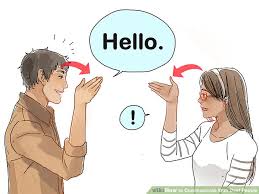
TODAY’S ARTICLE IS mainly intended for the deaf. Our well-researched strategies for improving communications skills are not actually intended for other categories of the disabled. This is so because communication barrier/difficulty has consistently been said to be the major problem that is consistently faced by people with deafness. So, in this essay, we want to focus on a unique need of the deaf- enhancing communication skills.
The ability of the average deaf individual to use a language skillfully, to speak and write excellently, to make coherent, intelligent arguments has been undermined by their inability to hear- significantly affected in particular, by a sensorineural hearing loss that has occurred before the development or acquisition of language.
However, research findings have also revealed that difficulty in communication by the deaf is also possible even after sufficient language has been acquired well before the occurrence of a hearing loss. We see a gradual loss of verbal ability in an individual after they have lost their auditory functionality.
Study after study has found that an increasing number of individuals with deafness- profound or severe hearing loss, pre-lingual or post-lingual hearing loss, are having difficulties with communication- troubles with recognizing English sounds and symbols, in constructing and coherent English sentences in acceptable grammatical and semantic parameters, and lastly, problems with understanding semantics and other rudimentary elements of the English language.
The consequences of the poor use of language by the deaf are very great. A poverty of communication skills affects an individual’s self-confidence, social and interpersonal skills, employment placement and opportunities. Furthermore, communications difficulty affects a deaf learner’s academic performance, relationships, and emotional well-being. Because for the last two effects, other people won’t understand one very much, and neither will one comprehend them as much, leading to a psychological breakdown on the part of the deaf individual with very poor verbal skills.
We identify and discuss five proven strategies for improving your communications skills as an individual with deafness.
- Read Books- Lots of it: The single-greatest way to speak correctly and intelligently is to read plenty of stuff- books and magazines, newspapers and journals, storybooks and children books. In fact, not only does reading improve communication ability, but it also helps with writing skills which is an even more profound ability. But like President Lincoln, who became a lawyer through reading, you can self-educate by being a voracious reader, and become all that you want to be.
- Break Out of the Deaf Culture Mentality: Culture and community is a wonderful thing. However, you can behave like everyone but thinks remarkably differently. And if you find yourself on the side of the majority way too much-consistently, you may be not doing yourself a world of good. To imbibe an excellent linguistic culture, it is essential to have a broader mindset, mingle and socialize with the broader world and you are testing each other’s theories, and over time, people learn from each other, because you’re getting out of your own narrow point of view and having a broader point of view- ultimately improving social skills which include communication.
- Grow and Function in A Rich Oral Language: The sign language- a manual form of communication for the deaf, is remarkable, but so is practicing oralism- a system of communication that involves using the lips, the tongue, the mouth, including the production of sounds to convey information to the deaf. Rather than rely on sign communication only, the deaf can learn to live and interact with the hearing world and lip-read and study the production and mechanics of sounds. Rather than keep mute, and flap arms about, a deaf individual can learn to read and raise their voice.
- Learn a Second Language: Bilingualism- the ability to speak a language well other than a native language, has been proven to improve English language competency in deaf learners A raft of research has shown that second language learning affects reading ability, social skills, and scholastic achievement. Similarly, research suggests deaf persons who learn a second language are more creative and better at solving complex problems than those who do not.
- Learn to Write More Often: Like reading, writing has been proven to enhance spoken and written skills. You do not need to write like an author or a popular writer. Having the courage to construct simple sentences about an observation, or writing a short story or composition about something or event can assist in communication. Take baby steps, and observe significant improvement in your ability to speak and write correct English expressions that ultimately makes you a healthier person.
Hearing is critical to speech, communication and language development. Yet, for the deaf, learning to communicate correctly and effectively is even more difficult- for at least a staggering number of deaf persons in Africa- a region where over 85% of persons with disabilities do not have access to education or opportunities for personal advancement. However, speaking and writing correctly is an art that requires smart personal strategies that we have, in detail, discussed above. We encourage you to actively consider them.
You are deaf and could communicate well- probably better than a lot other deaf persons. Can you share with us how you have improved your abilities to speak and write correct English?
Thank you.
2 comments
Wonderful website. Plenty of useful info here. Im sending it to some friends ans also sharing in delicious. And naturally, thanks for your effort!
cliff-douglas
Thanks very much for your comment. Feel free to share.