


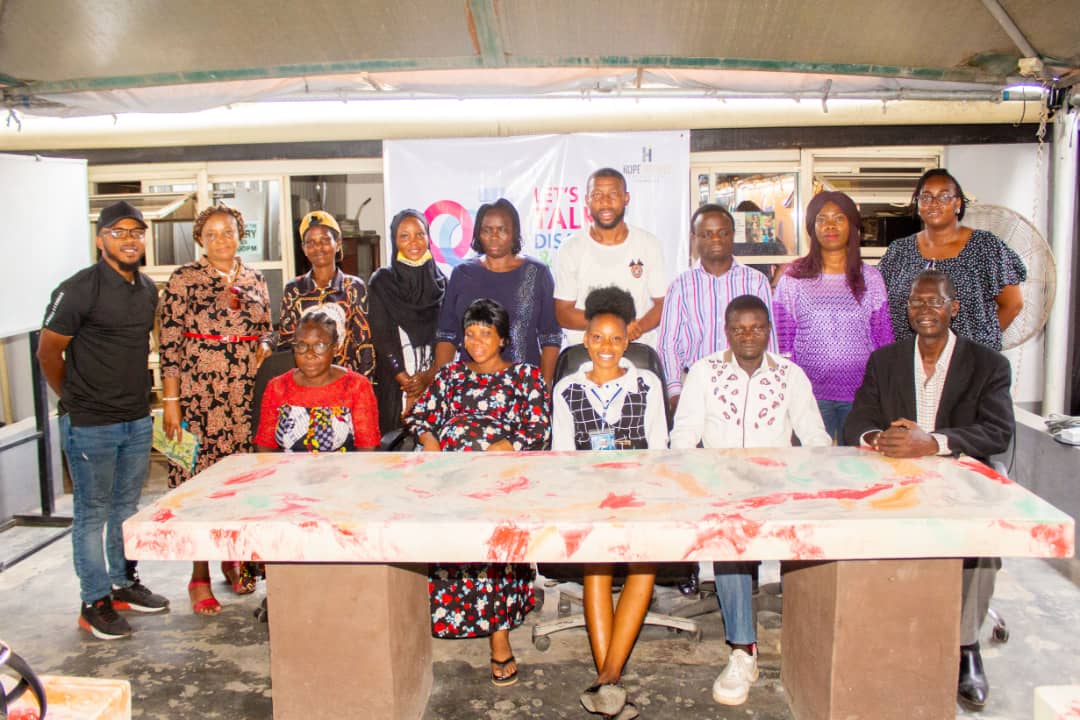
Penultimate Tuesday, as the world celebrated this year’s International Women’s Day, Hope Inspired Foundation for Women And Youth (HIFWY) joined in the commemoration by organizing a media round-table discussion themed : “Addressing Gender Inequality Today For A Sustainable Tomorrow”.
The round-table discourse, aimed at advancing gender equality and achieving gender balance in the nation’s polity aligned well with the year’s IWD Global theme: “Breaking the Bias”.
Hope Inspired Foundation for Women and Youth (HIFWY), is an Non-Governmental Organisation, NGO promoting issues involving Women and Girls and those with disabilities.
In her welcome address to the media personnel, Program Manager of HIFWY, Mrs. Omolara Daniel drew attention to the importance of celebrating the International Women’s Day, noting that the United Nations designated the Day to celebrate women and create awareness on peculiar needs and challenges facing women all over the world.
The day is celebrated with the aim of honoring women who have achieved tremendous impact in their careers and professions – including leadership roles.
According to Mrs Daniel, the day is also reserved to proffer solutions to identified problems and challenges of women. As part of activities to commemorate the occasion, advocacy is carried out to ensure drastic changes in the polity, policy formulations, and introduction of best practices in matters involving women.
Mrs Daniel also noted that the organization has previously organized events on sexuality education among Women and Girls with Disabilities, including training of over 30 Women and Girls on Sexual and Gender Based Violence and Disability perspectives.
She maintained that the NGO aims at educating society on the importance of sex education, and at same time reduce the suffering and exploitation of women and girls with disabilities. “Also, we hope to use sex education as an empowerment tool for women and girls with disabilities in order to afford them more fulfilling lives.”
Mrs Daniel pointed out that the project is being funded by Disability Rights Funds (DRF) – an International Grants Organization which is also overseeing a project: “Improving Sexuality Education for the Empowerment of Women and Girls with Disabilities in Lagos State”.
The aim is to create awareness about sexuality education among women and girls with disabilities.
Mrs. Daniel was however quick to point out that though the event is geared towards celebration of Women’s Day, it is also intended to give the media necessary assistance in publishing the voice of marginalized and vulnerable women and girls with disabilities.
According to the Project Manager, many of these victims have continued to suffer in silence from rape, sexual and gender based violence. We however believe that with media partnership, the voice of women and girls with disabilities will better circulate into public consciousness. At same time, active media involvement will ensure the subject of sexuality education is more fully embraced by the larger society.
During ensuing discussion by media personnel, efforts were made to find effective ways through which media can facilitate positive representations of sexuality education of women and girls with disabilities.
The round-table Panelists included Ms. Kudirat Amoda, Women leader, Nigeria Association of the Blind (NAB), Ikorodu Chapter; Mr. Ekundayo Sejoro – CEO, Inclusive News Network (INN) was ably represented by Mr. Adewale Adeyanju (Lagos Reporter for INN). Ms. Folashade Salimonu (LTV8) and Mr. Ayoola Efunkoya, Voice of Nigeria (VON) who acted as Moderator of the discussion.
The discussions examined society’s negative perceptions, misconceptions and biases which persist to such point that some believe that women with disabilities are sexually inactive and should not marry or have children.
It was noted that certain families, because of ignorance, continue to attach stigma to marriage between a non-disabled and a person with disability – same way marriage among persons with disabilities is viewed.
These kind of discriminations have been woven around women and girls with disabilities for so long that majority of them are unable to express themselves because they have no voice. A number of families have objected to marriage relationships with persons with disabilities.
Furthermore, as a result of lack of sexuality education among women and girls with disabilities – leading to rising cases of Sexual and Gender Based Violence (SGBV) against them, it has become imperative to take sexuality education to all nooks and crannies of the disability community and the larger society. Information, they say is Power.
Such approach is therefore the way to reduce exploitation of our women.
Mr. Rahman Finnih of Journalists Against Aids (JAAIDS) while speaking on the ordeal of women suffering from Sexual and Gender Based Violence (SGBV) and discrimination urged these women to speak out loud instead of keeping quiet.
It was agreed that in this present age of social media, everyone has a role to play. More so, while traditional media like electronic broadcasting stations and print media have limited capacity, with everybody getting involved the message can be amplified and well delivered. Phones, for example, can be used to take pictures, write and post on Facebook, Twitter, Instagram, WhatsApp and other social media handles.
Another aspect of handling the biases and discriminations is to phase out the use of certain derogatory appellations and insulting words. Such words should no longer be used in referring to a person living with disabilities.
According to Mrs Omolara Daniel, a number of names and words used to describe persons with disabilities are not friendly, she therefore suggested that words like: “Akanda” “eda”, “Odi”, “Afoju”, “imbecile”, “mentally retarded” and so on, should be discontinued.
Conversely, she reasoned that words like “disability”, “impairment”, “handicap”, etc, are just figures of speech which do not diminish the dignity of a Person with Disability, and, as such are okay.
Ms. Abiose Adams of The Cable opined that it is difficult to cancel some of these unsatisfactory words and appellations, however, she suggested that the disability community keep up engagement with Journalists in the quest for better words to use within disability contexts. She cited a special training facilitated at Ikeja by JONAPWD, Lagos State Chapter sometime ago to reshape media perception of PWDs as a good example.
The round-table meeting ended with participants drawing up individual goals to achieve tremendous impact in advocating for sexuality education of women and girls with disabilities. These include short, medium and long term goals.
General consensus was reached by all present on the importance of giving excellent publishing to the subject of sex education.