


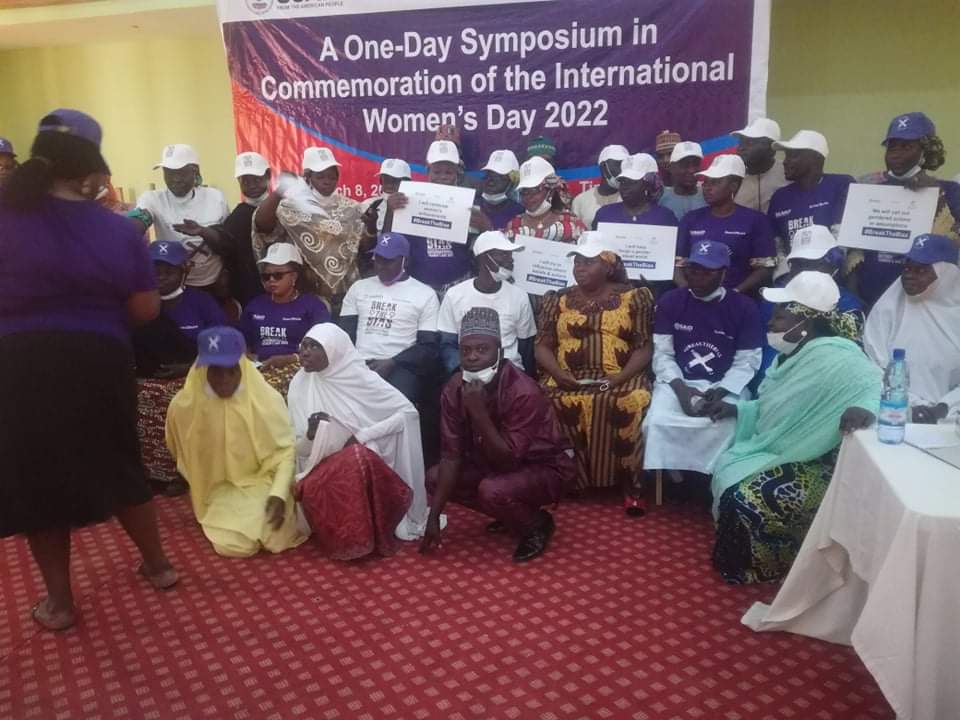
March 8 of every Georgian calendar year is a day set aside by the United Nations to exclusively reflect on challenges faced by women while celebrating their outstanding contributions and achievements across the globe. This year’s international Women’s Day themed “Break the Bias” laid emphasis on eradicating all forms of gender based barriers that keep women behind their male counterparts.
It was a busy day penultimate Tuesday as groups of women of different shades and status, including women with Disabilities (WDs) thronged the conference hall of Emerald Hill Hotels, GRA Quarters, Gombe State to celebrate the global event at the invitation of the USAID State Accountability, Transparency, and Effectiveness Awareness Department (a.k.a State2State)
Keynote speaker at the event, Mrs. Dudu Manuga, while delivering her lecture on the topic “Breaking Barriers” zeroed in on barriers that limit women from participating in various sectors of public life – especially Public Finance Management (PFM). She highlighted the key factors standing in the way of active participation of women Public Finance Management.
Manuga reiterates that women, like their male counterparts have all it takes to make meaningful contribution in Public Finance Management, but due to persistent bias and barriers they are sidelined and reduced to mere spectators by their male counterparts. She expressed concern that majority of women in public offices often occupy lower positions in the hierarchy. Often we see women in GL 15 positions and below in core public finance management sections of ministries, department and Agencies (MDAs).
Mrs Manuga backed up her position with comprehensive statistics of the number of women in public finance management institutions in Gombe State. The negligible numbers demonstrate the low participation of women in the PFM decisions.
The statistics further reveal that the Gombe State Ministry of Finance and Economic Development has zero female participation among its top ranking officials in Public Finance Management.
Meanwhile, the likes of Gombe State Internal Revenue Service (IRS), Budget and Planning Office, Office of the Accountant General has only one female among the senior finance officials. Also, the female to male ratio of Directors of Administration and Finance (DAF) in Gombe State is 9:40. This puts percentage at 22.5℅ female to 77.5 ℅ male Directors of Administration & Finance.
Manuga, a seasoned financial expert further lamented that women, especially women with disabilities are also seriously marginalized in the area of political appointment in the State. She observed that only two women were lucky to be commissioners despite the leading roles played by women during elections.
It was pointed out during the occasion that the ever increasing cases of bias against women and girls could be traced to several factors including cultural. “We see women staying at home under the control of men, an out-dated male domination model that shut out women from leadership roles.”
Instances of societal discrimination and stigmatization against women and girls, lack of mentors, low self esteem, lack of courage, envy, lack of role models and lack of strong support system, amongst others were listed as driving forces behind the various bias and barriers faced by women and girls.
In her reaction to the issues of bias against women with Disabilities, Miss Rebecca Hassan, Women Leader of the National Association of the Blind said women with Disabilities suffer the harshest form of parental, family and societal bias and negligence. This, according to her results in backwardness, depression and street begging. She noted that girls/women with Disabilities are often not enrolled in schools, instead they are often married off to irresponsible men who may later divorce them.
The Hon Commissioner of Gombe State Ministry of Women Affairs and Social Development, Dr. (Mrs) Naomi J.J Awak, told participants that “the theme of this year’s International Women’s Day Celebration “Breaking Bias” highlight the things that hinder progress of women. She went on to enumerate some of these things as denial of employment, early marriages, forced marriages, female genital mutation, sexual abuse, rape, denial of inheritance etc. Awak lamented that such is happening in the 21st century.
She reminded participants: “I want all of us to know that women are facing different forms of challenges which reduce them to slavery. How do we allow these to happen in the 21 century? There are prominent women who didn’t allow cultural biases to stop them. Examples are Ngozi Okonjo-Iweala, late Mrs Dora Akunyili, etc.
Here in Gombe State, we have Haj. Zainab Bulkachuwa, Haj. Amin L. Zubairu, Hon Aishatu Jibir Dukku, to mention a few. As a ministry, we will continue to engage women in workshops, symposia, sensitization, town hall meetings as we continue to stir their conscience to the dehumanizing condition we are in, Awak concluded.
INN learnt that the commemoration of the 2022 IWD came with exciting ways of breaking the enduring biases and barriers meted at women. It is believed that by putting these into practice, chances for equality of the genders will be enhanced in society.
The following steps were advocated: equal education for women and girls, developing self esteem and self-confidence of women and girls to believe in their nature-endowed potentials, massive women investment in agriculture, mentorship of young women by the successful elderly women, provision of special financial allocation for women Development in various fields, elimination of envy among women and girls, equal representation of women in MDAs and private institutions, and elimination of discrimination against women and girls with disabilities.
Others suggestions include encouraging the position of women combining marriage and education where necessary. Women are also encouraged to learn to adjust to the demanding task of balancing work and family.
Furthermore, women of higher status should not ignore those in lower statuses. Governments at all levels are encouraged to device strong gender policies that can stimulate development of women in all spheres of life.