


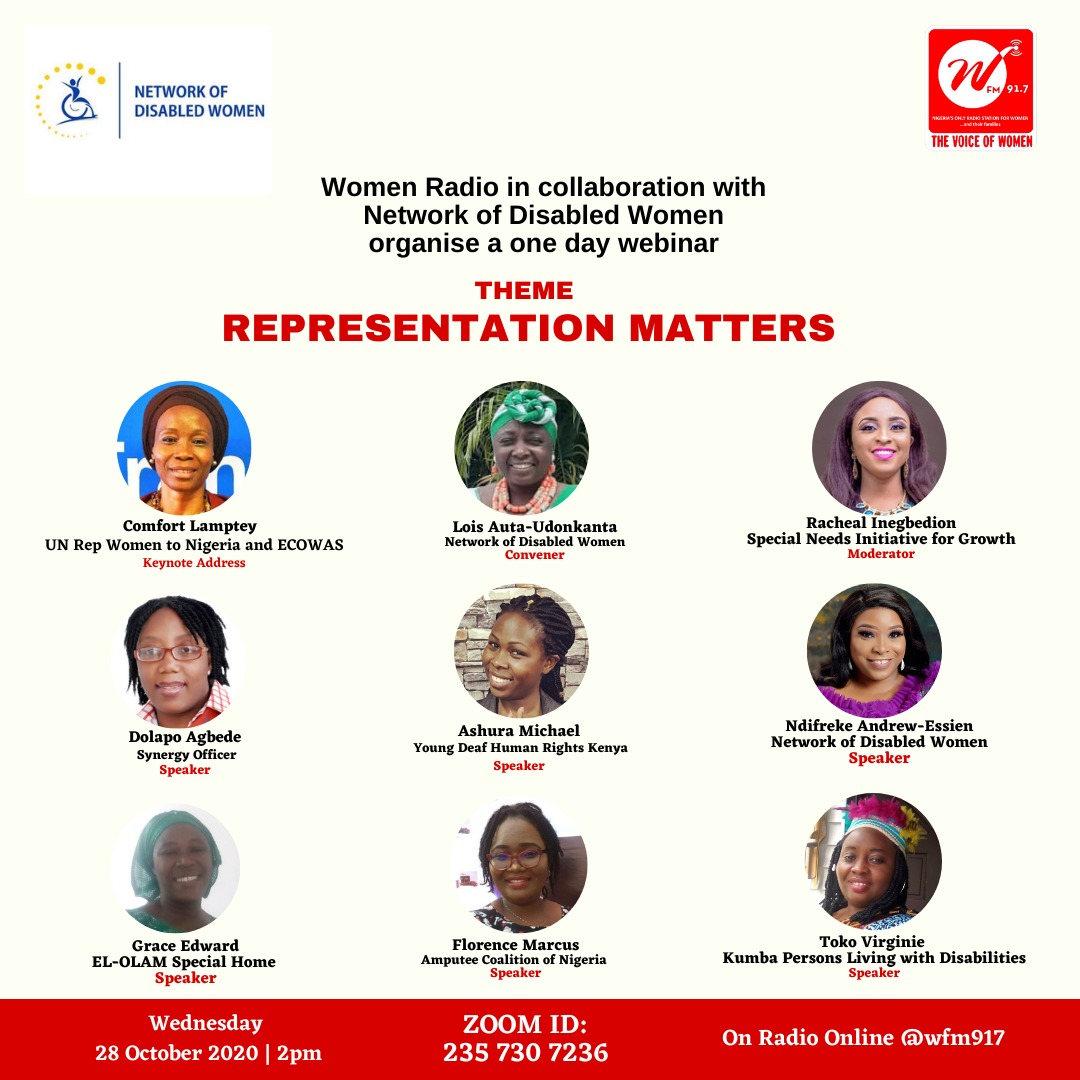
Network of Disabled Women, in collaboration with Women Radio, had in a virtual convention held on Wednesday called for domestication of the Disability Act at State level to prevent further cases of human rights violations of Persons with Disabilities (PWDs).
The Virtual Convention titled “Representation Matters” was put together with the aim of bringing stakeholders together to deliberate on issues hindering the participation of PWDs in the social, economic and political growth of the Nation. It brought together key personalities from the public and private sector. The event was held on 28th of October 2020 on Zoom.
In her opening remarks, Mrs Toun Okewale Sonaiya, the Executive Director of Women Radio noted that Persons with Disabilities have equal rights as their able bodied counterparts and that their disabilities should not limit their participation in every sphere of life.
She thanked the continuous support of UN Women, Federal Ministry of Women affairs and other key stakeholders for their contribution towards ensuring equal opportunities for Persons with Disabilities.
She pledged that the Women Radio will always offer platforms to persons with disabilities, especially women to ensure their voices are amplified.
The United Nations (UN) Women country representative, Mrs. Comfort Lamptey, in her keynote address stated that about 15% of Nigeria’s Population are persons with disabilities. The emphasis was that such percentage was significant enough to impact on national development, provided these people have a level playground.
She also noted that women and girls with disabilities are at higher risks of discrimination, marginalization and abuse compared to their male counterparts; consequently, a lot has yet to be done to bring an end to such injustices.
Commenting on the Disability Act, she pointed out that there is need for domestication of the act at the state level to ensure the rights of Persons with disabilities are fully protected at the grass root levels.
She commended the Network of Disabled Women and Women Radio for putting up such an engaging forum and called for more of such till equal opportunities abound in the society.
At the Panel Session, Moderator, Racheal Inegbedion asserted that Nigeria recently celebrated her 60th Independence yet the representation of Persons with disabilities within the social, political and economic sectors remains poor. The panel session therefore sought to address these challenges and point out what should be done to increase the representation of PWDs in every sector of the nation.
In her closing remarks, Lois Auta, the CEO of Network of Disabled Women thanked stakeholders that participated and contributed to the success of the convention.
According to the stakeholders, some key issues hindering inclusion of Persons with disabilities were listed as follows, Cultural barriers, Inaccessible systems, Lack of accessible information.
Others were, Economic dependence, Low Self-esteem among PWDs among others
On the way forward, the stakeholders listed some keys points that will intensify inclusion of Persons with Disability into mainstream society. It reaffirmed the need to immediately domesticate the Disability Act.
They added that massive awareness on the rights of PWDs is also essential, others listed are, Inclusive CSOs Intervention, Increased Public-private partnerships, Accessible information and systems.
The Convention agreed that Persons with Disabilities have potentials to become great leaders within the private and public circle, however as highlighted above, the prevailing Nigerian system has continuously denied them these fundamental rights.
With the emergence of the Disability act it is believed that these social ills against PWDs will end. As a matter of urgency, the stakeholders concluded that every State needs to start domesticating the disability act to ensure that there are no further cases of human rights violations of Persons with Disabilities.
The Convention also agreed that for total inclusion to materialize, there has to be a synergy between CSOs interventions, the private sector and the government. It is a collaborative effort of all the stakeholders involved.