


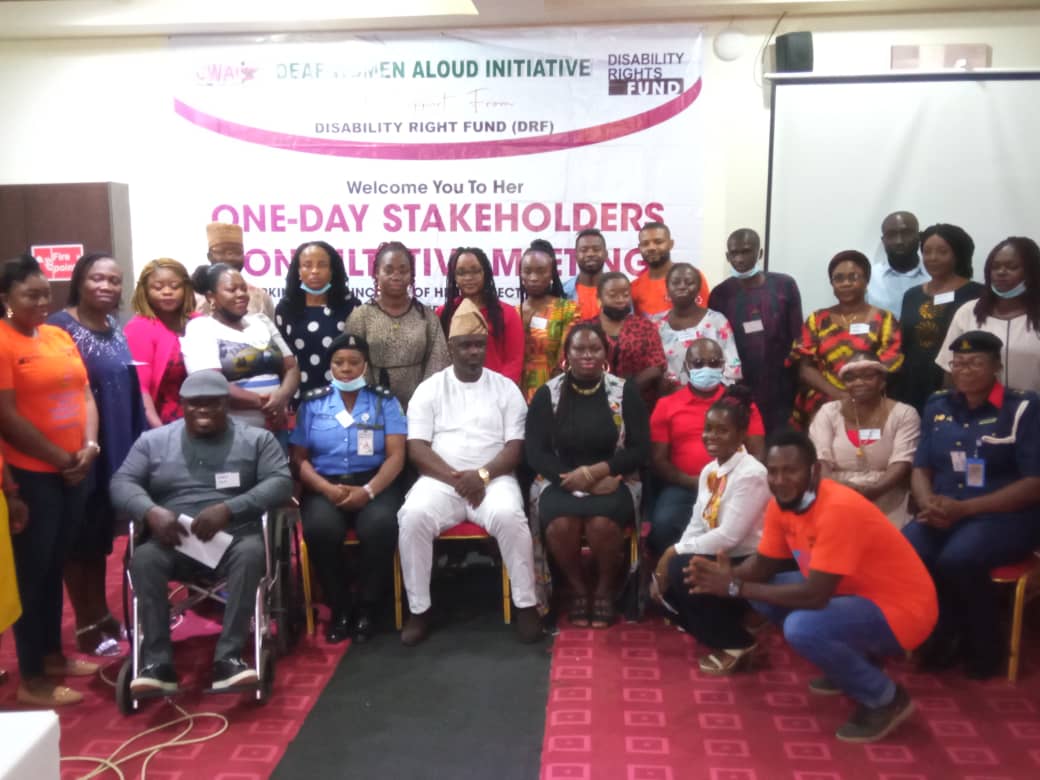
Deaf Women Aloud Initiative (DWAI) has launched a new project for advancement of rights of Deaf women and girls in the nation’s capital.
The project launching took place at a one-day event organized by stakeholders with support from the Disability Rights Fund (DRF).
The Executive Director of DWAI, Helen Beyioku-Alase, in her remarks noted that the project’s main aim is to create and maintain society’s awareness level on Deaf Women and Girls. The project also seek to advocate for implementation of existing laws, policies and programs aimed at preventing Gender based violence and providing sexual and reproductive health services, in line with United Nation Convention on the Rights of Persons With Disabilities, CRPD.
DWAI ED, Hellen Beyioku-Alase
Madam Helen further noted that Deaf Women and Girls are presently living in obscurity, deprivation, and silent misery.
According to Helen, a major obstacle preventing these marginalized group from achieving full justice on the issue of Gender Based violence is the hidden nature of their disability. Deafness makes it difficult to report cases of Gender Based violence.
Madam Beyioku-Alase notes that “Many women and girls with disabilities across the globe are standing up for their rights by making wise decisions regarding health and healthy living. They are now more enlightened on the how’s of preventing sexual and gender based violence (SGBV). However, it’s unfortunate that Deaf women having same sexual and reproductive health (SRH) rights as other women often face barriers to information and services.
“The society and individual see Deaf women as unfit to make information or decision about their sexual and reproductive health rights and will rather make decisions for them”.
“Government and private organization on the other hand, are increasing their efforts to alleviate the consequences of Gender Based Violence in the society. However, Deaf women are unlikely to benefit from policies and programs intended to address such problem. For example, The sexual Assault Response Centers (SARC) Police stations, hospitals are readily available for women but not deaf women as they cannot access such services due to communication barriers.”
The Nigeria Disability Act and United Nations convention on the right of person with disabilities (UNCRPD) stipulated and made it mandatory for all State parties and organization (Government and Non government) across the country to recognize the rights of Person with Disabilities, including Deaf women and Girls to access professional sign language interpretation in all facets of society’s life, meanwhile facilitating their accessibility.
“We hope at the end of the project, we will be able to produce a comprehensive training manual that tackles the subject of Violence against Deaf women and young girls in Nigeria, enhance Deaf women knowledge on Gender Based violence and its consequences, and provide guidelines for reporting of GBV related issues.”
We are also calling on both government and non government organizations, the international community, agencies and institutions to ensure the full participation of deaf women and girls in sign language interpretations – adding that “nothing about us without us”. We therefore insist on including Deaf women in service delivery for a more inclusive society.”
In her speech, the Hon Minister of Women Affairs, Dame Pauline Tallen, who was represented by the Assistant Chief Social Welfare Officer, Mrs Gloria Onwuzike, pointed out the wide gender gap that still exists in economic issues opportunities and growth. She said there is an urgent need to bridge the communication gap between deaf women and others in various sectors in Nigeria.
She disclosed that the Federal Ministry of Women Affairs had collaborated with the Federal Ministry of Humanitarian and Disaster Management in mid-2020 to train about 45 social workers on sign language and interpretations.
According to her “It is imperative to ensure that the rights of deaf women and girls in Nigeria are protected, especially amongst health workers when they seek access to sexual and reproductive health services,”
The program officer, Disability Rights Fund, DRF, Theophilus Odaudu noted that DRF is pleased to support DWAI in the cause of advancing the rights of Deaf women and girls.
Odaudu says “DRF is impressed with the level of improvement DWAI has made. He expressed hope that at the end of the project, there will drastic changes in the lives of deaf women.