


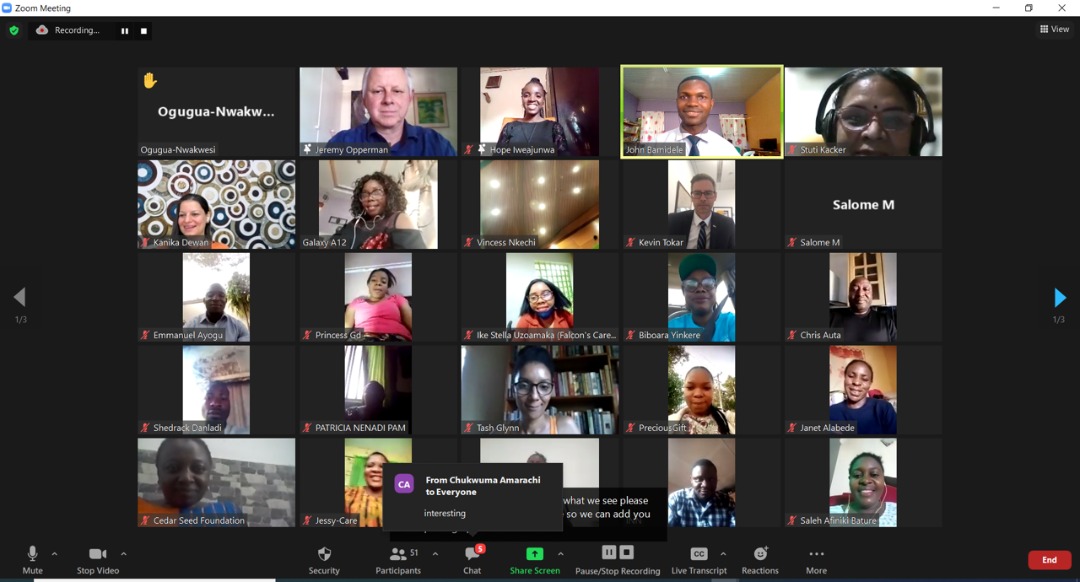
Experts in the Disability Community have called for more inclusion and greater diversity in areas of education and employment for PWDs in Nigeria and African countries.
The call was made at an event organized by Cedar Seed Foundation to commemorate the 2021 International Day of Persons with Disabilities (PWDs). The event brought together global experts, professionals and other high level representations from across public and private sectors.
Welcoming the audience, Cedar Seed Foundation CEO, Lois Auta-Udonkanta, remarked that “the objective of this dialogue is to remind ourselves of the precarious nature and consequences of unemployment and other economic crises faced by PWDs globally, while endeavouring to come up with solutions for addressing them in the short and long terms.
Udokanta revealed that the informal sectors which employ the largest workforce was the hardest hit during the lockdown period. Millions of people, particularly PWDs were pushed into unemployment and poverty during this time. This, coupled with harsh economic realities also led to the loss of jobs in the formal sector, resulting in Nigeria’s current unemployment rate of 83% of the 69.7 million labour force population. Hence our coming up with this idea to discuss how to engage PWDs in terms of employment.
A resource person at the event and former paralympic swimmer from the UK, Susie Rodgers, noted: “Companies need diversity and there is so much work we need to do on disability inclusion globally. Of course, these companies initiate inclusion policies, however, very often they don’t really cover Disability.
“We need to work together collectively to bring about change. People with Disabilities standing equally alongside people without disabilities, working towards a more inclusive, open and empathetic society where we draw on the great skills and value that every individual can bring to the table.
Rodgers stressed that “COVID-19 has adversely affected People with Disabilities all over the world. Some lost their means of livelihood, some lost education and the right to lead a life of their own choosing. Nonetheless there have been positives to these difficulties. For example, building disability inclusion into equitable access for vaccine globally, looking at hybrid and flexible working models, which maybe beneficial to some PWDs, etc. However there is still much work to be done on removing barriers that still exist for many.
Chairperson, National Commission for Protection of Children Rights, New Delhi, India, Stuti Narain Kacker asserted that Persons with Disabilities are being marginalized. The reason, according to her is because society don’t think they can be productive.
Stuti says: “Diversity is a kind of a thing in life. Everybody is unique, everybody has diverse capabilities and capacities God has given each of us.
“We have a right to an education act which give a legal framework for enforcing inclusive education. Our problem is population. Then there is sensitization, too.
“India has a perfect legal legislation part of the policy, however, implementation is difficult due to the large population. Furthermore, convincing so many people about the capacities of disabled poses another challenge. Fortunately, we are seeing a lot of change in people’s attitude. More people are accepting disabilities.”
Founder and creative director at Ka Design Atelier, Kanika Dewan urged PWDs not to see themselves as different. But to encourage co-creation in the educational system.
Dewan stresses: “You don’t see that disability, no, you rather see a ‘one soul’ concept. Someone who is blind has other senses heightened. There are qualities that people have through ADHD or autism, that people who do not have these disabilities cannot compete with. Sadly, we have categorized ourselves as disabled. We need to change that.
Continuing, Dewan noted: “if you give them (PWDs) a purpose, they can do anything. Purpose drives ability. Purpose drives movement, and that’s what we need to install through a value based approach. The challenge is: How do we get it?
“One approach is to reimagine a new schooling system where old buses are recycled to create schools. Note that these are buses that would otherwise be a detriment to the climate.
“We can convert them by using zero waste method. This can be done by engaging with companies with a zero waste management system mobile clinic. Next, we’re going to start transforming these into great schools.
“The above gives a picture of how we can reframe and reimagine the education system for integration. We are incorporating internship programs for students with Disabilities. We hope to bring in high level students from ivy league institutions to engage with them and co-create future challenges/solutions that address special needs.”
Acting High Commissioner of Canada in Nigeria, Kevin Tokar emphasized on the importance of improving access to education that meets the needs of Persons with Disabilities – especially improving access to education for technical and vocational skills that can help Persons with Disabilities fill important gaps in labor force of developing countries.
On their part, service providers, both public and private can connect employers with qualified candidates with disabilities while providing relevant assistance to employers in accommodating needs of these special employees.
INN reports that Persons with disabilities were advised on the need to address discriminatory prejudice, stigma and unique barriers they face particularly in the areas of economic empowerment and employment.
Tokar commended the Nigerian Government’s establishment of the National Commission for Persons with Disabilities. This, he said, is a big leap forward, an important milestone.
“We met with the Executive Secretary of the Commission to hear about its strategic priorities and we look forward to hear more on how these priorities would be practiced. We will also hold them accountable for implementing the law on PWDs in Nigeria.”