


Advocacy For Women With Disabilities Initiative (AWWDI) has enjoined women and girls with disabilities to rise above low self esteem and be imbued with a spirit of determination.
The charge came from the Executive Director, Patience Dickson in a speech during a two-day training for Persons with Disabilities.
The training was aimed at promoting the rights and perspectives of PWDs around the world. Supported by United Nations Population Fund (UNFPA), the event was organized in commemoration of the International Day of Persons with Disabilities.
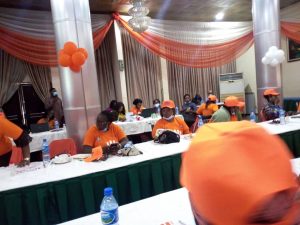
Some 63 representatives from the various clusters of the Disability Community were gathered at the event to brainstorm ideas on how best PWDs can independently integrate themselves into mainstream society.
Ably anchored by AWWDI Programme Manager, Pastor Kola Kolawole, the event featured presentations from the Minister of Humanitarian Affairs, Umar Farouq, deputy country representative of UNFPA, Erika Goldson, UNFPA Gender Based Violence (GBV) analyst, Olawunmi Laolu Akande, as well as a human rights lawyer Barrister Uzoma Aneto.
While delivering a speech on “Disability and Self Esteem and Challenges of Leadership”, Dickson said that fear of marriage by some PWDs have to do with low esteem. She maintains that having education and personal income are some of the bolsters of self esteem.
Read Also: AWWDI Advocates For The Rights To Self Determination And Access To Justice For WGWD
Speaking further she said: “WWDs and PWDs experience low self esteem more than people without disability. She noted that low self esteem is mostly responsible for PWDs inability to fully participate and independently integrate into the community.
“Women and Girls with disabilities have little or no value for themselves. They are not able to achieve much in life without education and a means of livelihood. According to findings, PWDs in urban areas may have higher self esteem than those in rural areas. PWDs tend to become more vulnerable in emergency situations like the COVID 19 Pandemic. The end result is that this already marginalized community have become even more vulnerable in this Covid era.”
Dickson highlighted a number of the factors responsible for low esteem. These include: disability/impairments, stereotypes and myth, self image/feeling of deformity, neglect/isolation at home, school, and IDP camps, etc.
Other factors according to her include: lack of Access to infrastructure and information, over protection and over dependence, lack of education, lack of employment and/or skills, negative mindset and perceptions.
Dickson urged PWDs to be motivated, confident, and feel good about themselves.

Human rights lawyer, Barrister Uzoma Aneto, in her presentation titled: ‘Your Legal Rights as a Woman and Girl with Disabilities in Leadership’, called on PWDs in the country to take their destinies in their hands by ensuring things work well for them.
Representative of the Humanitarian Affairs Minister, Mrs. Olurunfemi Bernice and the deputy country representative of UNFPA, Erika Goldson unanimously agreed that PWDs are mostly exposed to Sexual And Gender Based Violence (SGBV), stressing the need for more inclusion of PWDs in the society.
The Minister expressed government commitment to implement policies that support accessible post covid 19 initiatives for PWDs.
During the interactive session, it was disclosed that Participants expressed dismay over failure of the government to make facilities accessible for PWDs three years after it made the commitment.
Access to justice for PWDs whose rights are violated as well as systematic barriers were also front burners during the interactive session.
Other challenges identified by participants include: lack of access to employment opportunities, architectural or physical barriers, lack of access to information and communications technology, lack of education, lack of acceptance by mainstream society and attitudinal/behavioral barriers.
The following resolutions were jointly arrived at the meeting:
1. Facilitators and participants demanded more inclusion for PWDs to achieve Sustainable Development Goals (SDGs).
2. Government was urged to empower Persons with Disabilities in the areas of skills development, employment and socio-political and economic participation.
3. Participants called for an inclusive Policy framework and budget implementation.
4. Calls were made for systems and processes with no discrimination and inclusion into national, State, and local government covid19 committees.
5. They further demanded that PWDs and their families should be involved in policy designs, implementation and monitoring.
6. They called for continuous capacity building trainings for PWDs with emphasis on leadership skills.
7. Participants advocated for greater awareness, particularly on community sensitization to change mindsets and individuals perceptions on Disability.