


When the World Health Organization (WHO) launched its “Vision 2020”, it was based on the prediction that 76 million people would go blind by last year. In collaboration with the International Agency for the Prevention of Blindness (IAPB), WHO’s Vision 2020 goal was to, eventually, prevent about 100 million people from going blind.
As is the case with most developing nations challenged by healthcare needs, blindness and ailments associated with the eyes are serious matters in Nigeria. Indeed, the nation’s blindness and visual impairment survey was very revealing about the state of eye care and impairment in the country. The report, which was conducted between 2015 and 2017, suggests that over one million individuals aged 40 years are currently blind in Nigeria. A population of 2.7 million adults in the same bracket are estimated to have moderate visual impairment and an additional 400,000 adults are severely visually impaired.
A hospital-based retrospective study in Edo State showed that over 6% (555) of new patients seen with the period of the study were uniocularly blind while 3.9% (354) were binocularly blind. The leading causes of uniocular blindness were cataract, open-angle glaucoma and corneal ulceration/leucoma. Binocular blindness was mainly due to cataract, open-angle glaucoma and aphakia. The prevalence of blindness in the study population is high. Cataract, as the main cause of blindness, will require surgical relief, either in the teaching hospital or preferably in the patient’s locality. Appropriate interventions needed to be evolved (in the form of either mobile clinics or a series of surgical eye camps) to stem the present trend toward high prevalence of avoidable blindness. Prevention of ocular trauma is an essential factor in the reduction of blindness in children. Health education and bringing ophthalmological care to the doorstep of underprivileged rural dwellers will improve their level of awareness. It is in this dire context that SEPLAT’s “Eye Can See” is situated.
Towards supporting the fulfilment of Sustainable Development Goals (SDG) 3 which promotes good health and well-being, the inclination to support the World Health Organization’s goals, and the Nigerian National Programme for Prevention of Blindness, Seplat Energy Plc, an Indigenous Energy Company launched a Corporate Social Responsibility (CSR) Programme themed “Eyes Can See” in the year 2012.
Seplat Energy Plc (SEPLAT), operator of the NPDC/SEPLAT Joint Venture, has for years, brought succour to community members of its areas of operation, with its Eye Can See programme.
The aptly titled “Eye Can See” initiative is one of SEPLAT’s CSR initiatives executed annually in the Company’s host communities, with focus on providing comprehensive, quality and free eyecare to members of the host communities and states. Since the inception of the Programme almost a decade ago, the “Eye Can See” initiative has brought community dwellers face to face with specialist optometrists, which has continued to lift many people from poverty and extreme poverty.
Dr. Chioma Nwachuku, the Director, External Affairs and Sustainability, Seplat Energy, in her remarks, said that ensuring sustainability of the communities where SEPLAT operates remains top of the company’s agenda, particularly as it concerns the health and well-being of the people.
Nwachuku explained: “We are committed to partnering with our host communities with the view to touching lives. The “Eye Can See” intervention programme has been on since 2012, and every year, the company brings a dedicated team of medics to ensure it makes the right and needed impacts. Our focus on the good health and well-being of our people is unwavering, and this is in line with Sustainability Development Goal (SDG) 3 to ensure healthy lives and promote wellbeing of all at all ages.”
Welcoming the company and dignitaries to the palace, Chief John Oviesogie, the Eribo of Benin, who represented the Oba of Benin, lauded SEPLAT for supporting and enhancing the physical and mental wellbeing of members of its host communities and pledged the kingdom’s continuing support to the company and its activities. He commended the company’s resolve to continue to invest in its areas of operation, saying the move had helped to boost the communities’ fortunes.
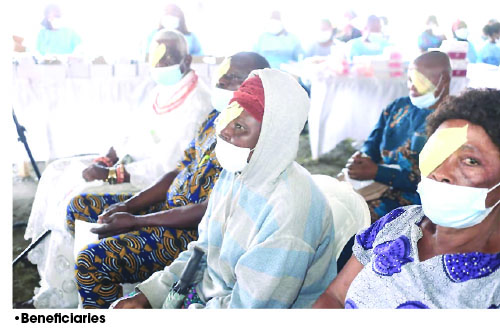
The “Eye Can See” programme is in addition to other yearly social programmes deployed by SEPLAT in her areas of operation. Beneficiaries of the programme who received free eye screening and treatment, many of whom had their sights restored following surgery, commended the company for bringing hope to their lives and giving them the opportunity to maximise their potentials. This initiative, strengthens the patient’s capability to generate income for themselves and their families, especially in the prevailing economic challenges.
Considering the state of health indicators and the urgent need to address health challenges in Nigeria, this move by NPDC/SEPLAT, has indeed largely helped in improving the health of many Nigerians as a lot of people do not have access to essential health services as a result of undue financial hardship, which has pushed them into extreme poverty.
As usual, the free premium optical care intervention programme, which is open to anyone that comes to the venue, witnessed a large turnout of people from within and outside Benin City. Over the years, numerous Nigerian citizens within Edo, Delta, and other SEPLAT operating states, have received surgeries worth hundreds of millions of naira for free through the “Eye Can See” programme.
For companies to excel, they must align themselves with the global development priorities and ensure they fuel and catalyse the global efforts towards achieving Sustainable Development Goals (SDGs). The SDGs were adopted precisely on September 25, 2015, by 193 countries as a follow up to the Millennium Development Goals.
Worldwide, corporate organisations are now key drivers of SDGs. Many corporate bodies should leverage Corporate Social Responsibility (CSR) to achieve the SDGs for sustainable growth in a holistic manner for the people and the communities where they operate.
Seplat have proven its intent to adhere to global best practice. which has been demonstrated in the areas of economic empowerment, health, and education which the eye can see and the recently held STEP CSR programmes are case in point.
Nwachuku noted that SEPLAT has through its eye can see programme, impacted 80,194 persons; dispensed 35,755 reading glasses, and performed 3,456 cataract and related surgeries.
If all the corporate organisations were to tow this route of Seplat Energy, the burden of underdevelopment and social restlessness particularly in the oil producing areas in the state would be greatly reduced. This programme therefore places Seplat Energy at the top of the corporate social responsibility in the state, and by extension has won the hearts of people in its host communities.