


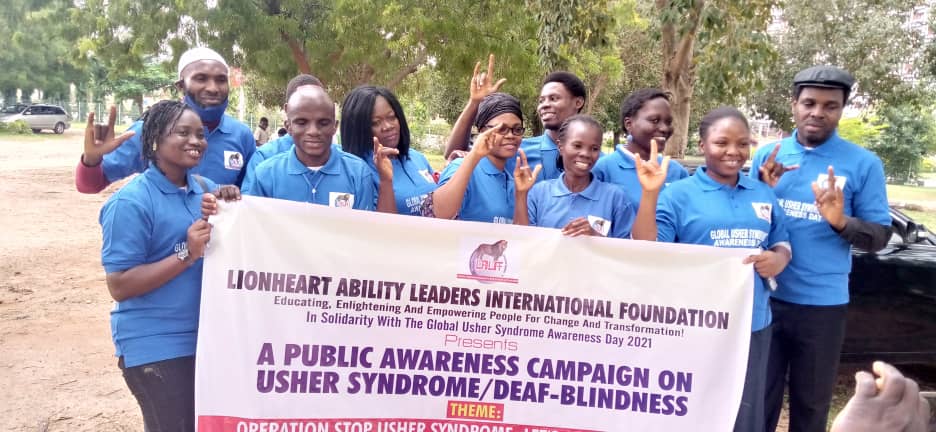
Solomon Okelola has revealed that lack of knowledge and access to training on Usher Syndrome among health practitioners hasn’t helped diagnosis and prompt treatment among persons with the condition in Nigeria.
Okelola disclosed this in a media chat with our correspondent at a one day public awareness campaign on Usher Syndrome (deaf-blindness) in commemoration of International Usher Syndrome Awareness Day. This year’s theme was “Operation Stop Usher Syndrome: Let’s give individuals with deaf-blindness in Nigeria a future”.
The Lionheart Ability Leaders International Foundation, LALIF, Executive Director noted that in Nigeria, people living with Usher Syndrome suffer much because of society’s ignorance of the condition.
He gave instances of deaf people in Nigeria suffering various kinds of marginalization just because of their inability to hear – pointing out that these deaf persons have sight. Drawing a parallel, the advocate asked: “if the deaf whose only challenge is hearing are hated and discriminated against, what do you think of individuals with deaf-blindness?
The Deaf-blind crusader went on to point out that the foregoing simply means that they (Usher Syndrome victims) suffer thrice what the deaf pass through in Nigeria.
According to Okelola, these individuals with a combination of hearing and visual impairments face three times the difficulties experienced by the deaf in communicating. Consequently, these people are always on their own. No one to talk to, no one understands them or what they need, no access to education and nobody cares! It is thus a very delicate situation.”
It is for these reasons that the Lion-heart Ability Leaders group organized the awareness campaign to educate government and society on Usher Syndrome and to find possible ways to prevent its spread.
Usher syndrome is the major causes of deaf-blindness. It is a genetic disorder caused by mutation of the genes. The condition results in a combination of hearing loss, and visual impairment. It is the leading cause of deaf-blindness in individuals worldwide.
Speaking further Okelola said ” it is of paramount importance that our health practitioners have good knowledge of this condition in order to devise ways for early detection and prevention as well as to stop the spread.
“Society should get in step, especially schools and parents of children with deaf-blindness, they should be trained on how to communicate with their wards, love them, treat them well and be fair to them”.
‘Also, there is the issue of education. Deaf-blind persons can be trained in schools with the right facilities and resources. These individuals should be sponsored through schools with special teachers who are experts in deaf-blind education.
Okelola invites the international community to assist them by working hand in hand with the Government. He also solicits support in forms of funding and trainings for health practitioners so that they can help provide the needed support individuals with deaf-blindness need to develop a sense of belonging.