


Cedar Seed Foundation recently announced the launch of a research study on how corruption impacts Persons with Disabilities, PWDs in the nation’s capital.
The report titled “Impact of Corruption on Persons with Disabilities in the Federal Capital Territory” was carried out among individuals, Government establishments, and civil society groups within the FCT with support from Sheu Musa Yar’adua Foundation. Focus was on the six area councils: Abaji, Bwari, Gwagwaglada, Kuje, Kwali and Abuja Metro Area Council (AMAC).
It pointed out that persons with disabilities are the most affected by corruption in the FCT.
The study reveals that corruption has eaten deep in the Nigeria Government system with bribes and kickbacks as among the most prevalent. Other forms of corruption are favoritism, tribalism and nepotism, gross embezzlement by Government officials, fraud, employment racketeering, double standards, extortion, and lack of accountability.
Also, there are increasing cases of the evil of corruption as exam malpractices, internet fraud, falsification of results, and unauthorized increment in prices of goods and services, delayed services, advance fee fraud, impersonation, internet and cyber-crimes.
This Cedar Seed report aims to analyze the extent to which corruption has affected Persons with Disabilities. It also seeks to identify the unique and disproportionate impact of retail corruption on the lives of PWDs in Nigeria. It examines how Civil Society Organizations (CSOs) can collaborate with Organizations of Persons with Disabilities, OPDs, in combating the menace in Nigeria. Also highlighted in the study were collective actions to address peculiar impacts of retail corruption on PWDs in FCT.
Read Also: Our PWDs Need Affordable, Inclusive And Accessible Health Services: Lois Auta tells NASS
These collective actions targeted different stakeholders consisting of PWDs, the National Orientation Agency, Government departments and agencies, Nigeria Security and Civil Defence Corps, United Nations Educational, Scientific, and Cultural Organization, UNESCO, The Independent Corrupt Practices Commission (ICPC), public office holders, CSOs, OPDs and Media organizations.
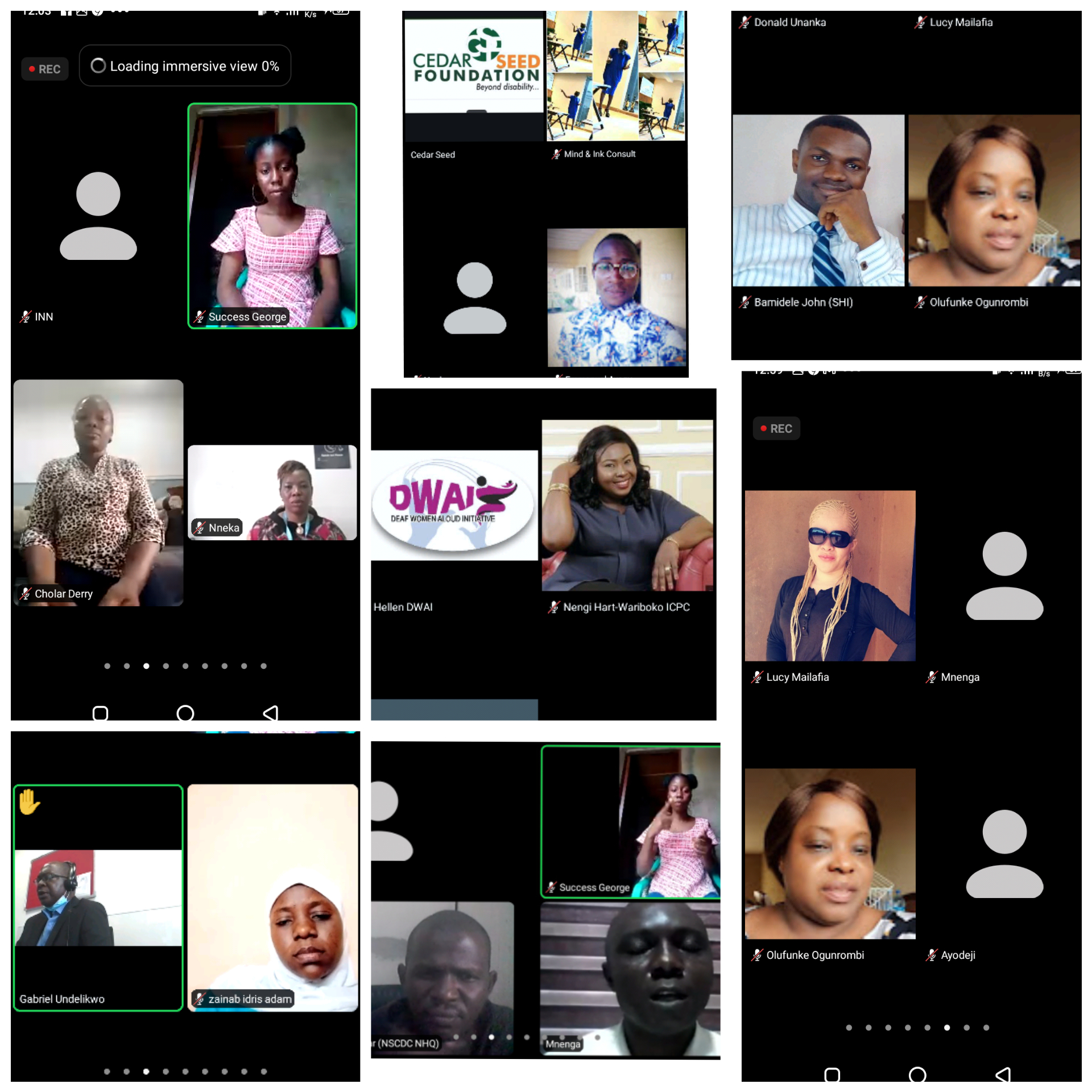
In attendance were representatives of OPDs from Nigeria and Kenya, Associations of PWDs, UNAIDS, Nigeria, Sign language interpreters, UN Resident Coordinator Office, UNDP, among others.
The pilot project which spotlights FCT, identified how Discrimination and corruption enables and exacerbate each other in four distinct ways:
1. Discrimination can lead to greater exposure to corruption.
2. Certain forms of corruption are inherently discriminatory.
3. Discrimination can mean that corruption has a disproportionate impact on certain groups especially PWDs.
4. Discrimination presents barriers to challenging corruption. On the other hand, corruption can obstruct victims of discrimination from accessing justice
The group made the following recommendations to mitigate the impact of corruption on PWDs
1. The need to vote Persons with Disabilities so that the interest of PWDs could be catered for.
2. The need to ensure Persons with Disabilities are part of round table conversations and policy making.
3. Hold the National Orientation Agency accountable to pass necessary information and communication about Persons with Disabilities.
4. Government Agencies should set aside departments for the needs of Persons with Disabilities.
5. Departments for PWDs: Human Resources and Consultants for easy identification of capacities of Persons with Disabilities.
6. Hold Public Holders accountable and follow the money upon approval of budget.
7. Education of Persons with Disabilities.
8. Collaboration with persons not living with disabilities, to ensure perfect union of voices.
9. More attention to be given to corruption in educational sectors, corruption that affects the health sector and corruption in the transport system.