


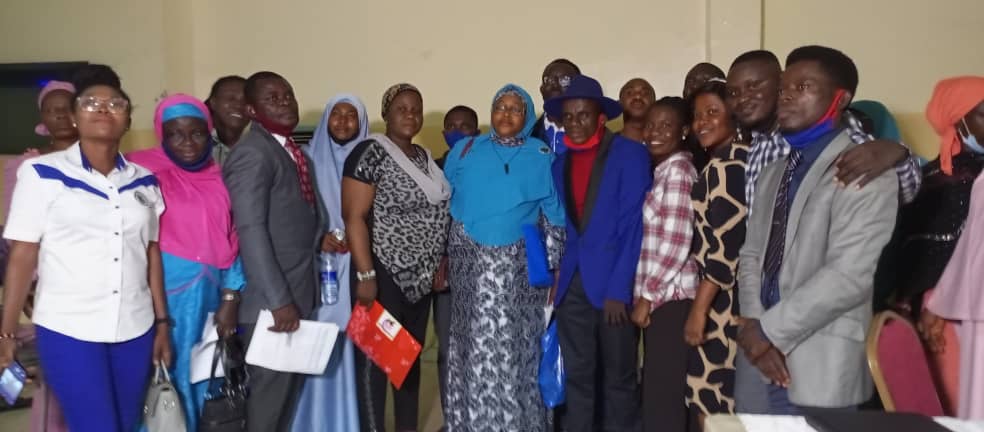
Lionheart Ability Leaders International Foundation, LALIF has pinpointed a lack of communication and inaccessibility to learning facilities as major reasons teachers sideline deaf-blind children in an inclusive classroom setting.
The group disclosed this during a capacity-building workshop on effective communication systems and teaching methods for individuals with deaf-blindness. The Workshop themed: “Building a future for individuals with deaf-blindness in Nigeria” was held in conjunction with the Lagos State office of disability affairs to train teachers, parents/ relatives/friends of individuals with deaf blindness.
LALIF lamented that individuals with deaf-blindness are not recognized in Nigeria because their education isn’t popular and most special teachers lack the required expertise to enhance communication with deaf-blind children. Most times, even knowledge of the best method of teaching for this type of children is non-existent. Consequently, instances of abandoning deaf-blind children are rampant.
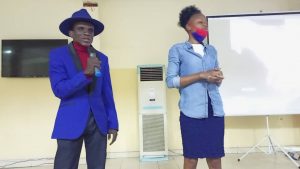
L-R: Solomon Okelola with an interpreter
The Executive Director of LALIF, Solomon Okelola, revealed that the number one challenge is the fact that many people lack the capacity to educate or socialize with people with deaf-blindness in Nigeria.
He said “Everyone should know that the individual with deaf-blindness has unique needs and to meet these needs, teachers of the deaf-blind need to learn to communicate with, understand, and teach those individuals so that they can be included in the classroom.
“Individuals with deaf-blindness maybe be hard to educate because of the concurrent visual and hearing loss. However, it isn’t entirely impossible to teach them.”
Mr. Okelola listed specific aids deaf-blind learners required to help their learning. These include braille, touching sign language, large pages and raised letters, moon writing and padona method of speech reading, etc. He noted that these aids make it much more easier for the deaf-blind to read and recognize letters.
According to the Executive Director of the group, some deaf-blind individuals have low vision, some others have residual hearing. He noted that both residual faculties can be very helpful in the learning process. Sadly a number of core equipment needed by these individuals are not available in Nigeria.
Okelola decried exclusion of the deaf-blind at the recently concluded data collection of Persons with Disabilities by the Federal Government, adding that he doubts individuals with deaf-blindness were included during the exercise because majority of these individuals are locked away in their homes by parents and other family members who do not know how to involve them in everyday societal life.
Solomon disclosed that most specialists in the Nigeria disability community are not even aware of the term ” deaf-blindness “.
He noted that this category of disability was not even mentioned among the disability clusters listed in the data collation forms. Furthermore, most medical practioners have never even heard of ushers syndrome, the major cause of deaf- blindness.
“This is why we are raising the level of awareness on the education and health of this disability cluster among government officials so they are informed about the condition.”
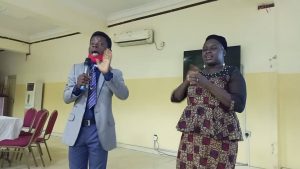
Friday Azanor with an interpreter
Project manager at LALIF, Mr. Friday Azanor remarked that there are no specially trained teachers on the psychology or education needs of children with deaf-blindness.
According to him, “Most times when you visit a school for the hearing impaired, you ask if they have a child with deaf-blindness and they say no. On further explanation however, they might answer in the affirmative, saying oh, we have some such children in our school.
“Now ask the teachers how do you communicate with them and they might admit their helplessness. So we see these children are most times abandoned in their own world right there in the classroom”.
Mr. Azanor noted that there are different methods of communication to use in teaching children with deaf-blindness
He urged the government to give in-service training to special teachers to facilitate communication with these children. School curriculum should also be adapted to meet their needs.
There should be at least a course that focuses on education of the deaf-blind – a specific course for learners with deaf-blindness. With this the teacher will be able to use knowledge of sign language and other communication methods like braille to teach persons with deaf-blindness in Nigeria.
The workshop which was supported by Disability Rights Fund had the program officer, Mr Theophilus Odaudu participate through virtual call to address the audience.
Mr. Odaudu expressed confidence in the all round inclusion of Nigerians with deaf-blindness in the nearest future through the work of Lionheart Ability Leaders International Foundation. He therefore enjoined all to join hands in the work.
Participating parents and teachers expressed joy at learning new solutions to the challenges of Ushers Syndrome while calling for more intensive training on the issue.
A mother related how she taught her deaf-blind son his husband’s name so that he is able to provide the information in the case of an emergency. She says she even went as far as writing her phone number on the back of his clothes. She related how teachers complained of inability to teach the boy and how they always put him to sit at the back of the classroom. She was grateful for the training and called for more so children like hers can have their academic and other needs provided for.
1 comment
[…] Read Also: Deaf-Blindness: Lack Of Communication And Accessibility Responsible For Classroom Exclusion R… […]