


Inclusive Friends Association, IFA, has released to the public, ‘Closing the Gap’, a research report on the participation of Persons with Disabilities in the ongoing Continuous Voters Registration (CVR).
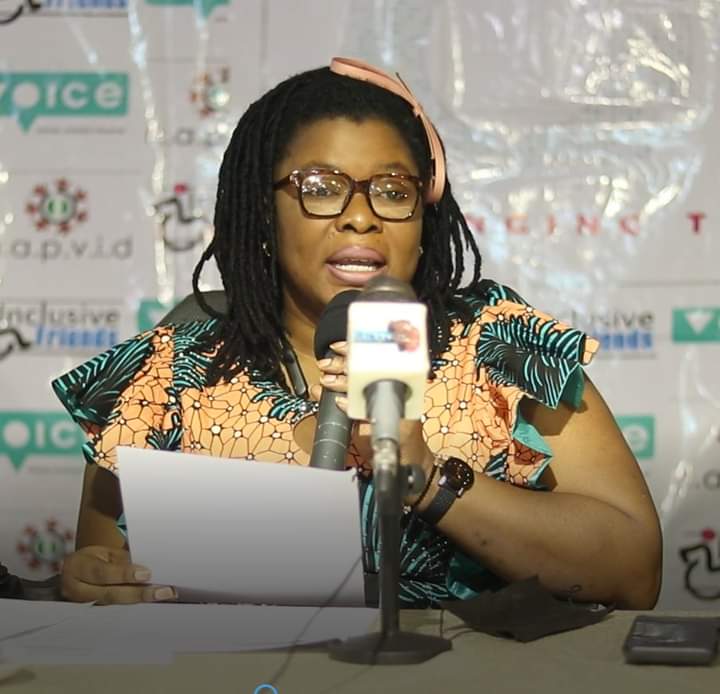
The report was presented to the public by IFA Executive Director, Grace Jerry, on behalf of ‘Data for Inclusion’ and ally Organizations.
Commenting at the presentation to the public, the IFA executive director pointed out that the ‘Data for Inclusion’ project became necessary, primarily because Persons with Disabilities were not identifiable in the voters register of the Independent National Electoral Commission (INEC).
She noted that the organization was able to collect data of registered voters with disabilities across 13 States and provided this to INEC for effectively planning for this category of voters during elections. The data also assisted the Commission to deploy voting materials during the off-season elections last year.
“In the course of data collection, we realized that most persons with disabilities are not registered and do not possess voters cards to participate in elections. A good number don’t even have requisite knowledge on how to engage in active politics.
“This, in effect, means that we have a lot to do in the area of creating awareness. Likewise civic and voters education should be accessible to Persons with Disabilities to encourage participation in the electoral processes.
According to IFA, the research was conducted mainly to identify and understand some of the factors responsible for this low participation of Persons with Disabilities in the CVR process, factors that go beyond the obvious marginal reasons most of us know about.
Read Also: CVR: IFA commends INEC for capturing PWDs concerns
The research was conducted in Abuja, Adamawa, Edo, Ekiti, Enugu, Ondo, and Sokoto States to provide adequate spread that would assist the group to understand the similarity and differences in the problems.
IFA expressed excitement that at this stage of the Continuous Voters Registration (CVR), INEC has introduced a disability clause in the CVR form that asks prospective voters to indicate whether or not they have any form of disability.
According to Jerry, ‘this is a development we are excited about and we hope INEC continues to implement more recommendations that would make the electoral process accessible and inclusive for all Persons with Disabilities’.
The group made some recommendations to INEC stating that distance is a major factor responsible for low participation of PWDs in the CVR. It tasked INEC to employ roving/mobile registration across communities within PWD clusters to reduce cost (disability-related) of registration.
“Data of voters with disabilities by clusters should be published to assist organizations of Persons with Disabilities to plan better initiatives which encourage more participation of the PWDs community in the CVR exercise.
“Registration officers must continually train to ensure they attend to Persons with Disabilities with utmost dignity as they exercise their franchise.
“As INEC increases the number of registration centres nationally, the physical accessibility of the locations should be prioritized in the selection of such locations.” Jerry said.
The Executive Director also urged the National Orientation Agency, NOA, to ensure that in its role of sensitizing citizens of government’s activities, Civic and Voters education should be an integral part of its messaging, especially messages that reach Persons with Disabilities.
“Disability and persons with disabilities should be introduced in the sensitization of the National Youth Service Corp to enable Corp members get familiar with disabilities before they are recruited as ad-hoc staff in the pre or election phase.”
IFA advise leaders of Persons with Disabilities to increase their voices to encourage more persons with disabilities register and be eligible to participate in elections. Beyond voting, it said “let us encourage more PWDs to run for office in local, State, and national elections, especially with 2023 in sight.”
Grace wants the National Commission of Persons with Disabilities (NCPWD) to play the big role of working and influencing the national assembly especially the House Committee on Disability matters to provide a budget to enable the Commission conduct massive civic education targeting Persons with Disabilities.
Beyond Voters education initiatives, the commission should work with its various line ministries to ensure the physical accessibilities of locations used as polling units and registration centres in later phases of the registration exercise.
She tasked the media to support Organizations of Persons with Disabilities (OPDs) by providing Voters education messages in accessible formats to reach various clusters of disabilities, and at a reduced cost.